Most shooters understand that powder is what makes a firearm discharge, but far fewer grasp how profoundly propellant selection shapes real-world cartridge performance. Powder doesn’t simply burn; it burns along a precisely engineered curve, at a defined rate, under controlled pressure, and within strict performance thresholds.
Differences in powder type, burn rate, energy density, and pressure curve, directly influence muzzle velocity, chamber pressure, recoil impulse, and terminal consistency. Understanding this relationship isn’t reserved for handloaders, it’s what separates informed shooters from those relying on guesswork.
This guide breaks down powder types by chemical composition and grain structure, explains how burn rate governs internal ballistics, and shows how to align propellant characteristics with your cartridge, barrel, and intended use.
What Is Powder in a Cartridge?
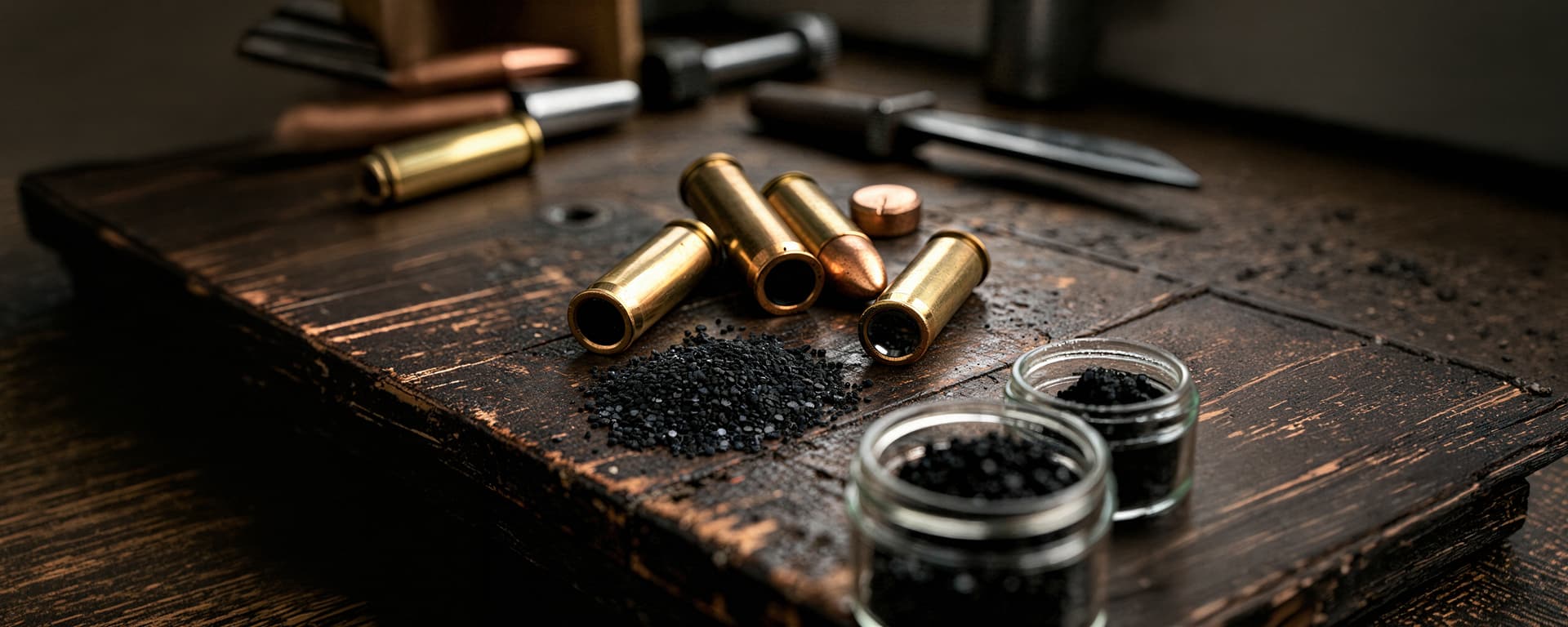
Powder, more accurately referred to as propellant, is the working force behind every fired round. It converts the primer’s ignition into controlled, sustained pressure that drives the bullet downrange.
The Role of Propellant in Ammunition
When the firing pin strikes the primer, it ignites a small but intense flame that flashes into the powder charge. The propellant then combusts rapidly, producing expanding gases that build pressure behind the bullet and force it through the bore.
This entire process unfolds in milliseconds, yet every variable, from ignition consistency to burn rate, has measurable consequences at the target.
How Powder Generates Pressure and Velocity
Contrary to common belief, modern propellants do not explode, they burn progressively. This controlled combustion is what allows pressure to build, peak, and sustain in a predictable way.
Burn rate determines:
- How quickly pressure rises
- The peak pressure achieved
- How long pressure is maintained behind the bullet
When properly matched to cartridge and barrel length, this results in efficient energy transfer and consistent muzzle velocity. When mismatched, it leads to wasted energy, excessive muzzle flash, erratic velocities, or dangerous pressure spikes.
Common Types of Powder Used in Cartridges
Modern smokeless powders fall into three primary chemical categories:
| Type | Composition | Key Characteristic | Common Grain Shape |
| Single-Base | Nitrocellulose only | Temperature-stable; clean burn | Extruded (stick) / flake |
| Double-Base | Nitrocellulose + nitroglycerin | Higher energy output; faster pressure rise | Ball (spherical) / extruded |
| Triple-Base | NC + NG + nitroguanidine | Low flash; primarily artillery/military | Extruded |
Single-Base Powder
Composed primarily of nitrocellulose, single-base powders are widely regarded as the standard for precision rifle applications.
They offer:
- Exceptional consistency
- Reduced temperature sensitivity
- Clean, predictable burn characteristics
For hunters and long-range shooters operating across varying climates, this stability translates directly into reliable point-of-impact.
Double-Base Powder
Double-base powders incorporate nitroglycerin alongside nitrocellulose, increasing energy output and accelerating pressure development.
Key advantages:
- Higher potential velocities
- Efficient energy use in compact cases
These powders are commonly found in handgun cartridges and high-performance factory loads where velocity and energy take priority over temperature stability.
Triple-Base Powder
Triple-base formulations add nitroguanidine, reducing flash signature and flame temperature.
In practical terms:
- Primarily used in military and artillery applications
- Not relevant to civilian small arms or reloading
Powder Grain Shape: Why It Matters
Beyond chemistry, powder geometry plays a critical role in burn behavior and metering consistency.
How Powder Burn Rate Influences Cartridge Performance
Burn rate is the defining variable in internal ballistics. It determines how a cartridge behaves from ignition to muzzle exit.
| Burn Rate | Best Suited For | Typical Applications | Cartridge Examples |
| Fast | Short barrels, pistols | Pistol / light loads | 9mm, .45 ACP, .38 Special |
| Medium | Standard rifle cartridges | Versatile rifle / handgun | .223 Rem, .308 Win (lighter loads) |
| Medium-Slow | Larger rifle cartridges | Full-power rifle loads | .308 Win, .30-06 Springfield |
| Slow | Magnum & high-capacity cases | High-velocity rifle, heavy bullets | 6.5 Grendel, .458 SOCOM, .45-70, .44 Mag (rifle) |
Fast-Burning Powders
- Rapid pressure buildup
- Optimized for short barrels
- Common in pistol cartridges like 9mm and .45 ACP
Medium Burn Rate Powders
- Balanced pressure curve
- Versatile across multiple platforms
- Suitable for cartridges like .223 Remington and lighter .308 loads
Medium-Slow Powders
- Ideal for full-power rifle loads
- Deliver consistent performance in cartridges such as .308 Winchester and .30-06 Springfield
Slow-Burning Powders
- Designed for large-capacity cases and heavy bullets
- Maintain pressure over longer barrels
- Critical for magnum and big-bore hunting cartridges
Key Ways Powder Type Affects Cartridge Performance
Muzzle Velocity
Powder selection directly determines velocity potential. A properly matched burn rate maximizes energy transfer, while a mismatch can result in significant velocity loss.
Chamber Pressure
Each powder produces a unique pressure curve. Incorrect selection can lead to:
- Dangerous pressure spikes
- Incomplete combustion
- Inconsistent ignition
Adhering to SAAMI pressure limits is non-negotiable.
Accuracy and Shot Consistency
Consistent powder behavior produces tighter velocity spreads, translating to improved accuracy, especially at distance.
Recoil Characteristics
- Fast-burning powders: Generate a sharp, abrupt recoil impulse due to rapid pressure spike
- Slow-burning powders: Produce a longer, smoother push as pressure is sustained through the barrel
- Perceived recoil: More noticeable in lightweight rifles and during extended shooting sessions
- Big-bore cartridges (e.g., .458 SOCOM, .45-70): Powder choice directly impacts shootability and follow-through
- Load optimization: Proper powder selection balances performance with manageable recoil for better control and accuracy
Powder Type and Barrel Length Interaction
Propellant burn rate effects and barrel length are two sides of the same equation. A slow-burning powder in a 6-inch pistol barrel is wasted energy, the bullet exits before the powder finishes burning, and you’ll see the unburned result as a fireball at the muzzle. A fast-burning powder in a 24-inch rifle barrel peaks pressure too early and delivers the bullet a long section of bore where nothing is accelerating it.
- Fast powders: Best in short barrels (2–6 inches for pistols; 10–12 inches for SBR applications). Designed to complete their burn efficiently in the short time the bullet is in the tube.
- Medium to medium-slow powders: Match the pressure curve to standard-length rifle barrels (16–22 inches). The most common category for general hunting and tactical use.
- Slow powders: Built for long barrels and large cases. Lever-action rifles, magnum carbines, and large-bore AR platforms are where slow powders earn their place.
Mismatching powder and barrel length doesn’t just leave performance on the table in extreme cases it creates pressure and reliability problems. This is one of the reasons factory-loaded premium ammunition uses carefully developed load data rather than generic powder selections.
Choosing the Right Powder for Your Cartridge
Consider Cartridge Case Capacity
Larger cases need slower powders to fill the available volume efficiently and maintain pressure through the bore. A small pistol case loaded with a slow magnum powder is a recipe for a squib load. A large rifle case loaded with a fast pistol powder is a recipe for a dangerous pressure spike. Case capacity is the first checkpoint in any powder selection decision.
Match Powder to Bullet Weight
Heavier bullets require more sustained push to reach their velocity potential. Lighter bullets accelerate quickly and exit the bore before slow powders finish their burn. For heavy hunting bullets in large-bore cartridges, slow-burning powders are not optional, they’re required to deliver sustained pressure and effective terminal performance. They’re the only practical match for what those bullets need to do their job cleanly.
Intended Shooting Purpose
- Precision rifle work: Temperature-stable single-base powders with consistent grain geometry. Shot-to-shot velocity spread is the metric that matters.
- Big-game hunting: Slow-burning powders matched to heavy bullets and full-length rifle barrels. Terminal performance depends on reaching minimum expansion velocity, and powder selection determines whether you get there.
- High-volume practice: Ball powders that meter accurately and flow consistently through reloading equipment. Efficiency per round matters more than marginal velocity gains.
At Steinel Ammo, powder selection is part of the load development process, and not an afterthought. Every cartridge is built around a specific powder, bullet, and velocity target chosen to deliver consistent terminal performance in the rifles and handguns you actually use.
Safety Considerations When Selecting Powder
Powder selection errors can have serious consequences. These aren’t guidelines, these are rules.
- Always use published load data from a verified source. Never work from memory or estimates.
- Never substitute powders without verified load data for that specific substitution. Burn rates that look similar on a chart can produce very different pressure curves in the same case.
- Stay within SAAMI pressure limits. Exceeding them risks catastrophic firearm failure and personal injury.
- If a load produces sticky case extraction, flattened primers, or any sign of excess pressure, stop immediately and consult published data before continuing.
Key Takeaways
Powder types and cartridge performance are directly linked at every level, from the primer flash to the bullet’s behavior at the target.
- Burn rate is the single biggest determinant of how a cartridge performs in a given barrel. Match it to your case capacity, bullet weight, and barrel length.
- Single-base powders offer superior temperature stability, a meaningful advantage for hunters and long-range shooters in variable conditions.
- The four burn rate categories – fast, medium, medium-slow, and slow each have distinct applications. Propellant burn rate effects don’t disappear just because a round is factory-loaded.
Large-bore hunting rounds demand slow-burning powders and carefully matched bullet weights to perform as intended. There is no universal best powder. There is only the best powder for your specific cartridge, bullet weight, barrel length, and shooting purpose.
Frequently Asked Questions
Q1. Does powder type affect cartridge velocity?
A. Yes. Powder type determines the pressure curve, which directly influences bullet acceleration and final velocity.
Q2. Which powder type is best for rifle cartridges?
A. Most rifle cartridges perform best with medium to medium-slow powders, while larger cases require slower-burning propellants.
Q3. Can changing powder improve accuracy?
A. Absolutely. Matching burn rate to cartridge and bullet weight reduces velocity variation and improves consistency.
Q4. Why do different cartridges use different powders?
A. Because every cartridge has unique requirements, case volume, pressure limits, and bullet weight all demand specific burn characteristics.
Still not sure which powder or load is right for your rifle or handgun? Call us at (330) 840-7086. We’ll tell you exactly what to run.
Because your legacy deserves better than a guess.