
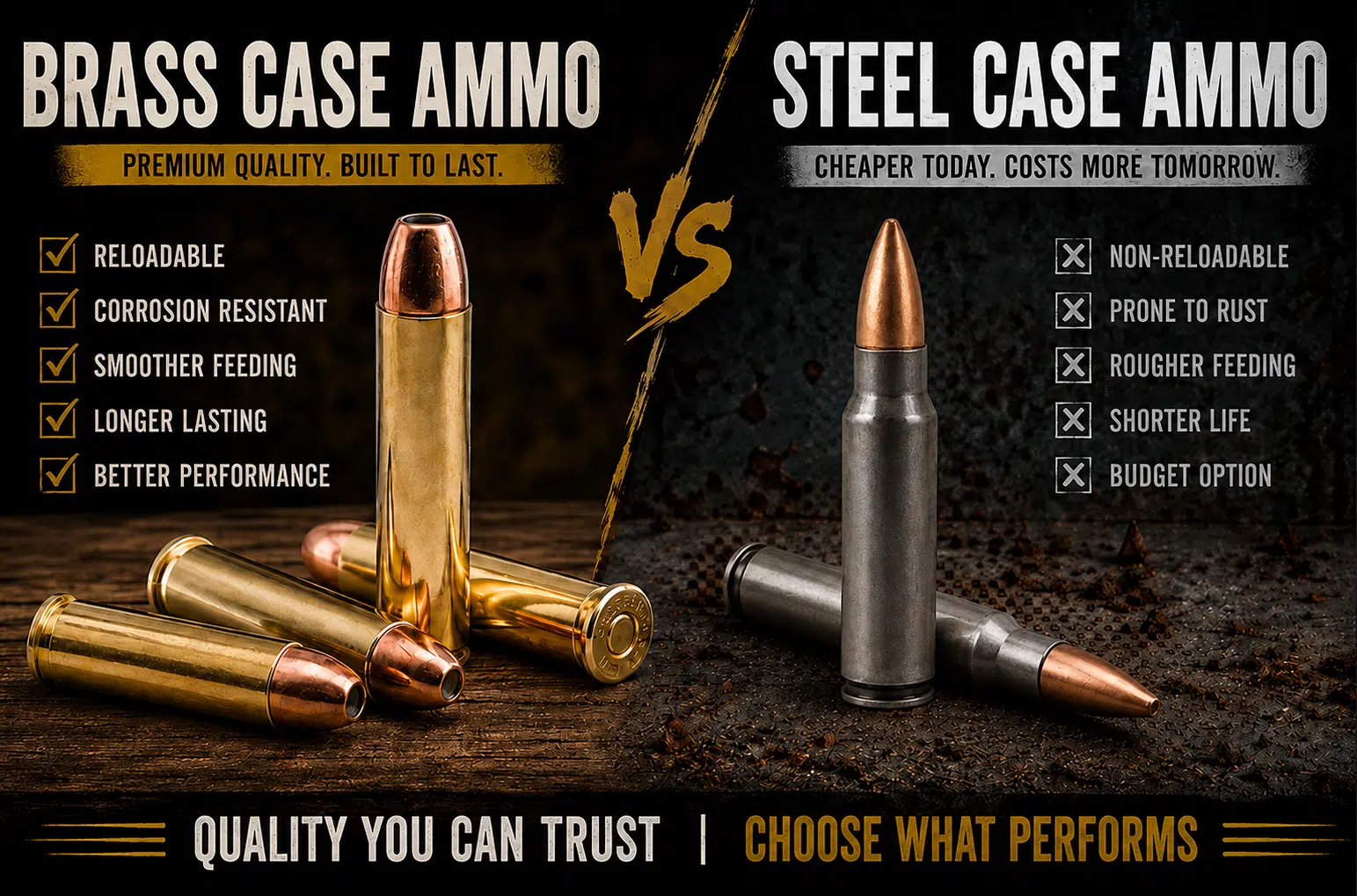
The steel-case vs brass ammo question comes up constantly – at the range, in gun stores, and on forums. It sounds like a simple cost comparison, but the case material affects how your ammunition performs in the chamber, how your firearm ages over thousands of rounds, and what your options are afterward. Understanding the real differences helps you make a better decision for your specific use.
What Is Brass-Cased Ammo?
Cartridge brass is a copper-zinc alloy – typically 70% copper, 30% zinc – chosen for a specific mechanical reason: it expands under pressure to seal the chamber, then springs back enough to extract cleanly. This property, called obturation, is what makes brass the dominant case material in premium and precision ammunition. Brass ammo cases expand more precisely under pressure, keeping gas from escaping rearward and contributing to consistent pressure and velocity.
Brass is soft enough to be gentle on extractors, resistant to corrosion without any coating, and capable of being resized and reloaded multiple times with proper care. These characteristics make it the standard for hunting loads, defensive ammunition, and any application where performance consistency is non-negotiable.
What Is Steel-Case Ammo?
Steel is harder and significantly cheaper to produce, which is why it appears almost exclusively in budget training ammunition and overseas military surplus loads. Among the most commonly encountered steel-case loads in the U.S. market are 7.62×39 cartridges for AK-platform rifles and bulk 9mm training ammunition from various overseas manufacturers.
This is commodity ammunition built to minimum specifications. It is designed to function reliably enough for training while keeping costs low. That’s the value proposition.
Because bare steel rusts, all steel-case ammunition uses a polymer or lacquer coating to protect the case surface. A steel case doesn’t expand and contract as smoothly as brass, which can make extraction stiffer – particularly in hot chambers after sustained fire.
Steel-Case vs Brass Ammo: Key Differences
| Factor | Brass Cases | Steel Cases |
| Chamber Sealing | Excellent – brass obturates to chamber dimensions | Adequate – harder case seals less precisely |
| Extraction | Smooth and reliable | Can be sticky, especially in hot chambers |
| Reloadability | Multiple reload cycles with proper care nickel plating adds corrosion resistance and a lower friction surface for smoother feeding | Not practical – brittle, work-hardens quickly |
| Corrosion Resistance | Good; ages well with proper storage | Requires lacquer/polymer coating to prevent rust |
| Accuracy Consistency | High – tight tolerances standard | Moderate – sufficient for training distances |
| Firearm Wear | Minimal – soft metal, gentle on extractor | Slightly higher on extractors over high volume |
| Cost | Higher per round | Lower – budget and bulk training use |
| Manufacturing Origin | Domestic and international premium manufacturers | Primarily overseas, budget/surplus production |
| Best Application | Hunting, defense, precision, reloading | High-volume range training, AK-platform use |
The core trade-off in the steel-case ammo vs brass decision is straightforward: brass cases deliver better chamber sealing, easier extraction, and genuine reloadability at a higher per-round cost. Steel cases deliver an adequate, inexpensive training round. Neither produces a meaningful practical accuracy advantage at typical range distances, but the performance gap matters considerably in any application where the shot has real consequences.
Brass Case Advantages
- Chamber sealing: Brass obturates to chamber dimensions, keeping chamber pressure consistent and preventing gas from escaping around the case.
- Clean extraction: The softer metal releases the chamber wall cleanly, minimizing extractor stress over thousands of rounds.
- Reloadability: Brass can be resized, reprimed, and reloaded multiple times with proper annealing and case preparation, a meaningful cost advantage for hand loaders.
- Consistency: Premium brass-cased ammunition is built to tighter dimensional tolerances, which translates directly to shot-to-shot velocity consistency.
- Hunting and defensive use: For any application where the round has to perform reliably on the first attempt, a brass case is the correct choice.
Steel Case Advantages
- Cost: The primary advantage. Steel-case training ammo typically runs meaningfully less per round than equivalent brass-cased loads.
- High-volume training: For shooters burning through hundreds of rounds in a range session with no intention of reloading, the per-round cost difference is real.
- AK-platform reliability: The AK-47 and its derivatives were designed around steel-case military ammunition. The platform’s generous chamber and robust extractor handle the harder case material without the reliability concerns that appear in tighter AR-15 chambers.
Does Steel-Case Ammo Damage Your Firearm?
The honest answer depends on volume, platform, and maintenance. The claim that steel cases ruin AR-15s is overstated, but it isn’t baseless.
At very high round counts, the harder case does slightly increase extractor wear. At typical shooter volumes, this isn’t a meaningful concern. The bigger practical issue is coating. In a hot chamber, lacquer softens and can leave residue that complicates extraction. Modern polymer-coated steel-case ammo has largely addressed this, but the distinction is worth knowing when selecting bulk training ammo.
AR-15 chambers are cut to tighter tolerances than AK chambers. Many shooters experience stiffer extraction in dirty AR-platform rifles after extended use of steel-case ammunition. It’s manageable with regular cleaning, but it’s one reason many shooters choose brass-cased 9mm and 7.62×39 ammunition. They want the performance of those cartridges without the extraction trade-offs that steel cases can introduce.
Steel-Case vs Brass for AR-15s and AK Rifles
AR-15: Brass-cased ammunition is the safer choice, especially for hunting, defensive, or precision applications. Steel-cased ammo is acceptable for high-volume training in a clean, well-maintained rifle if cost is the primary constraint.

American Tactical OMNI AR15 (Lower in polymer), Millett DMS-1 scope and FAB Defense stock and grips
Source – Wikipedia
AK-platform: Steel-case is natively appropriate; these rifles were designed around it. For hunting or defensive AK loads, brass-cased hunting ammunition is more commonly associated with premium bullets and tighter manufacturing tolerances, which can contribute to more consistent overall performance.

AKMS with a stamped Type 4B receiver (top) and an AK-47 with a milled Type 2A receiver
Source – Wikipedia
Can You Reload Steel-Case Ammo?
Technically possible; practically not worthwhile. Steel work-hardens aggressively on firing, making consistent resizing difficult. Most imported steel-case ammunition uses a Berdan primer configuration – two small flash holes instead of one central one – which is incompatible with standard American reloading dies and primers. Some steel-case ammo uses Boxer primers, but the case hardness issue remains regardless.
For reloaders, brass is the only practical case material. The cost and effort of working steel cases do not produce reliable results, and case life is significantly shorter than brass under repeated sizing.
Final Thoughts
Steel-case vs brass ammo comes down to this: brass cases are what premium ammunition is built from, because the mechanical properties of brass – obturation, elasticity, and consistent dimensional tolerances are what enable consistent performance. Steel-cased ammunition is an inexpensive overseas product built for training volume where precision is not the priority. For any shot that matters – hunting, defense, or serious precision work – brass is the correct answer.
Still not sure which case material is right for your rifle, your application, or your budget? Call us at (330) 840-7086.
Because your legacy deserves better than a guess.
Frequently Asked Questions
Is steel-case ammo bad for AR-15s?
Not inherently, but the tighter AR-15 chamber tolerances make stiff extraction more likely with steel cases, particularly after sustained fire. Brass-cased ammunition is the better choice for AR-15 applications beyond basic training.
Why is brass-cased ammo more expensive?
Brass costs more to produce than steel and requires tighter manufacturing tolerances to deliver its obturation and extraction advantages. For hand loaders, reloadability partially offsets the per-round cost premium. Steel-case ammo is less expensive because it’s a lower-grade, typically overseas product built for cost efficiency, not performance.
Can steel-case ammo damage extractors?
At very high round counts, the harder case material increases extractor wear slightly. At typical shooter volumes, this is not a significant concern. Regular cleaning and maintenance matter more than case material for extractor longevity.
Which is better for hunting?
Brass-cased ammunition. Reliable extraction, consistent pressure, and premium bullet compatibility make brass cases the correct choice for hunting applications.
Can you reload steel-case ammo?
Most steel-case ammunition uses Berdan primers that aren’t compatible with standard reloading components. Even Boxer-primed steel cases offer limited case life and are generally not worth the time or effort. For most reloaders, brass is the only practical choice.