The M16 rifle Vietnam War story is one of innovation, controversy, and continuous improvement. Introduced during one of the most challenging conflicts in modern military history, the M16 represented a dramatic shift away from traditional full-power battle rifles toward lightweight, high-velocity firearms designed for modern combat. While its early deployment was plagued by reliability issues that frustrated soldiers in the field, ongoing engineering improvements eventually transformed the M16 into one of the most successful service rifles ever adopted.
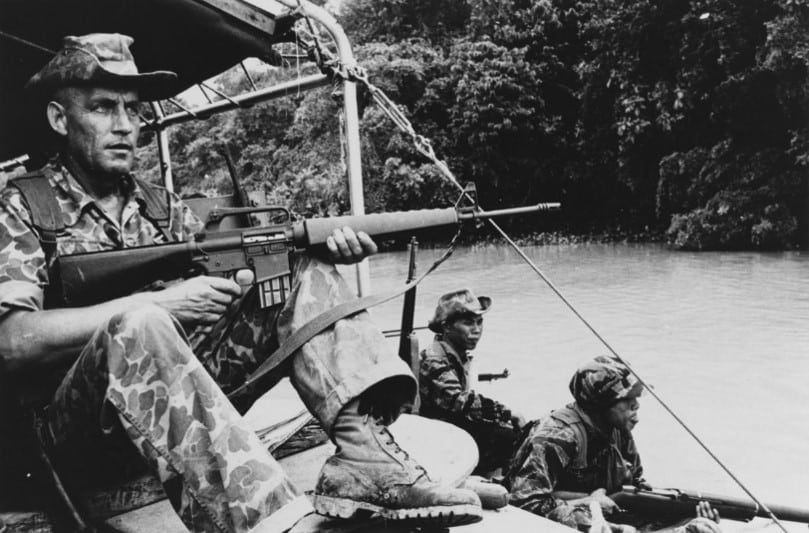
An early M16 rifle without forward-assist. Note: “duckbill” flash suppressor and triangular handguard.
Source – Wikipedia
Before Vietnam, U.S. forces primarily relied on heavier rifles chambered in larger calibers, reflecting military doctrine developed during World War II and the Korean War. However, the dense jungles of Southeast Asia exposed the limitations of these firearms, prompting the military to seek a lighter rifle that allowed troops to carry more ammunition without sacrificing effectiveness.
Central to this transformation was the adoption of 5.56 NATO ammunition, a smaller, lighter cartridge that offered higher velocity, reduced recoil, and increased ammunition capacity. Today, the M16’s influence extends well beyond Vietnam, shaping modern military rifles such as the M4 Carbine and countless AR-platform firearms used worldwide.
Whether you’re interested in military history, firearms development, or the evolution of modern ammunition, understanding how the M16 changed throughout the Vietnam War provides valuable insight into one of the most significant weapons programs in U.S. military history.
Military Rifles Before the M16
The M14 and Earlier Service Rifles
Before the M16 entered service, U.S. forces primarily relied on the M1 Garand and later the M14 rifle. The M1 Garand earned an outstanding reputation during World War II and the Korean War, while the M14 introduced a detachable 20-round magazine and the powerful 7.62×51mm NATO cartridge.
The search for a lighter infantry rifle began years before large-scale deployment in Vietnam. Studies such as Project SALVO and the Small Caliber High Velocity (SCHV) program concluded that soldiers were more effective carrying lighter ammunition and firing controllable rifles capable of rapid follow-up shots. These findings heavily influenced the development and eventual adoption of the M16.
Although highly accurate and dependable, both rifles were relatively heavy and produced significant recoil. As combat shifted to the dense jungles of Vietnam, soldiers found these full-powered battle rifles less practical for close-range engagements and extended patrols.
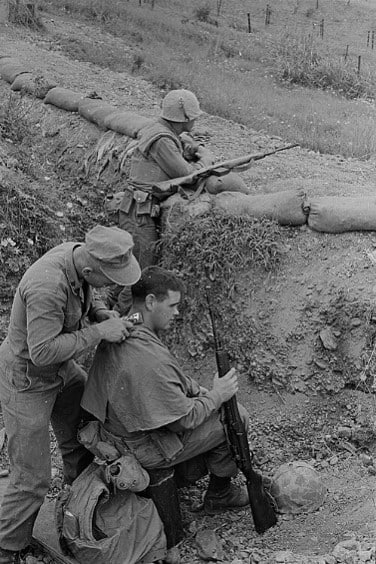
Three soldiers in a trench at Guantanamo Bay. Two are wielding M14 rifles, and one is giving a soldier a haircut
Sources- Wikipedia
Why the U.S. Military Sought a New Rifle
Military planners recognized the need for a lighter rifle that would improve soldier mobility and increase ammunition capacity.
Secretary of Defense Robert McNamara played a significant role in accelerating the adoption of the M16 after reviewing extensive testing that favored lightweight, high-velocity rifle systems over traditional battle rifles.
The new design is aimed at providing:
- Reduced overall weight
- Higher magazine capacity
- Lower recoil for faster follow-up shots
- Greater ammunition carrying capacity
- Improved effectiveness in jungle warfare
These requirements led to the adoption of an entirely new rifle platform.
Early Problems with the M16 During the Vietnam War
Reliability Issues in Combat
Despite its innovative design, the early M16 experienced significant reliability issues after being fielded in Vietnam. Soldiers reported failures to extract, excessive fouling, and malfunctions during combat.
Several factors contributed to these problems:
- Changes in propellant that increased carbon fouling
- A widespread belief that the rifle was “self-cleaning”
- Lack of issued cleaning kits and maintenance instructions
- Harsh jungle conditions involving heat, humidity, and dirt
These issues negatively affected troop confidence during the rifle’s early deployment.
The U.S. military responded by introducing chrome-lined chambers, improved ammunition, revised maintenance procedures, and proper cleaning equipment. These improvements greatly increased the rifle’s reliability and restored confidence among soldiers.
The Role of 5.56 NATO Ammunition
Why the Military Chose Smaller-Caliber Ammunition
One of the most significant changes introduced with the M16 was the use of 5.56 NATO ammo. Compared to larger-caliber cartridges, it offered several tactical advantages:
- Reduced recoil
- Higher muzzle velocity
- Lighter cartridge weight
- Increased ammunition carrying capacity
Soldiers could carry substantially more ammunition without increasing their overall combat load, improving endurance during long operations.
Battlefield Performance
The 5.56 NATO cartridge delivered excellent performance within the typical engagement distances encountered during the Vietnam War. Its flat trajectory and controllable recoil allowed soldiers to fire accurate follow-up shots while maintaining mobility in dense terrain.
Combined with the lightweight M16 platform, the cartridge helped redefine modern infantry tactics and later became the standard rifle ammunition used throughout NATO.
M16 vs M14 – A Vietnam War Comparison
| Feature | M16 | M14 |
| Weight | Approximately 6.5 lbs | Approximately 9.2 lbs |
| Caliber | 5.56×45mm | 7.62×51mm NATO |
| Magazine Capacity | 20 Rounds | 20 Rounds |
| Ammunition Weight | Lightweight | Heavier |
| Effective Range | Approximately 500 meters | Approximately 800 meters |
While the M14 offered superior long-range power, the M16 excelled in mobility, controllability, and ammunition capacity, making it better suited for the close-range conditions commonly encountered in Vietnam.
The Legacy of the M16 Rifle
Influence on Modern Military Rifles
The lessons learned during the Vietnam War directly influenced later military firearms, including the M16A2, M4 Carbine, and numerous modern AR-platform rifles. Improvements in manufacturing, materials, and reliability transformed the platform into one of the most widely adopted service rifles in history.
Historical Significance
Although its introduction was controversial, the M16 ultimately became one of the most successful military rifles ever produced. It served the U.S. military for decades and helped establish the widespread adoption of 5.56 NATO ammunition among NATO member nations. Its influence continues to shape military and civilian rifle development around the world.
Frequently Asked Questions
Q1. Was the M16 effective in Vietnam?
Yes. While early versions experienced reliability problems, improvements to the rifle and maintenance procedures made it a highly effective service weapon.
Q2. What was the best rifle used in the Vietnam War?
Both the M16 and M14 had strengths. The M16 offered superior mobility and ammunition capacity, while the M14 provided greater long-range power.
Q3. Why did the U.S. military stop using the M16?
The M16 has gradually been replaced by the shorter and more adaptable M4 Carbine, which better suits modern combat requirements.
Q4. Why did soldiers dislike the M16?
Initial reliability issues, inadequate cleaning equipment, and ammunition-related problems led to frustration during its early deployment.
Q5. Was the M14 better than the M16?
The answer depends on the mission. The M14 excelled at long-range engagements, while the M16 proved more effective in the close-range combat common during the Vietnam War.
Q6. What replaced the M16 for the U.S. military?
The M4 Carbine became the primary service rifle for most U.S. military personnel while retaining many design features of the M16.
Q7. How many rounds did an M16 hold in Vietnam?
The original M16 was issued with a standard 20-round detachable magazine. Later variants commonly used 30-round magazines.
Q8. Why is the AK-47 better than the M16?
Neither rifle is universally better. The AK-47 is widely known for its durability in harsh conditions, while the M16 generally offers greater accuracy, lighter weight, and lower recoil.
Conclusion
The evolution of the M16 rifle Vietnam War demonstrates how battlefield experience drives innovation. Although early reliability issues challenged its reputation, continuous improvements transformed the M16 into one of the most influential military rifles ever developed. Its lightweight design, high-capacity magazines, and adoption of 5.56 NATO