When shooters talk about ammunition performance, bullet weight is often one of the first specs discussed. Whether you’re selecting ammo for hunting, self-defense, or target shooting, bullet weight plays a critical role in how a round behaves once it leaves the barrel and once it reaches the target.
But bullet weight alone doesn’t guarantee performance.
At Steinel Ammunition, we’ve learned that bullet weight only matters when it’s paired with disciplined load development, consistent components, and rigorous testing. In this article, we’ll explain how bullet weight affects accuracy, recoil, and penetration, and why consistency matters just as much as the number printed on the box.
Understanding Bullet Weight
Bullet weight refers to the mass of the projectile itself and is measured in grains (gr). With 7,000 grains in a pound, even small differences in bullet weight can meaningfully affect velocity, recoil impulse, and terminal performance.
Within a single caliber, you’ll often see a range of bullet weights:
- 9mm commonly ranges from 115gr to 147gr
- .223 Remington/5.56 NATO often spans 55gr to 77gr
- .308 hunting bullets frequently range from 150gr to 175gr
Each weight offers tradeoffs. There is no universally “best” bullet weight-only the most appropriate one for the application and firearm.
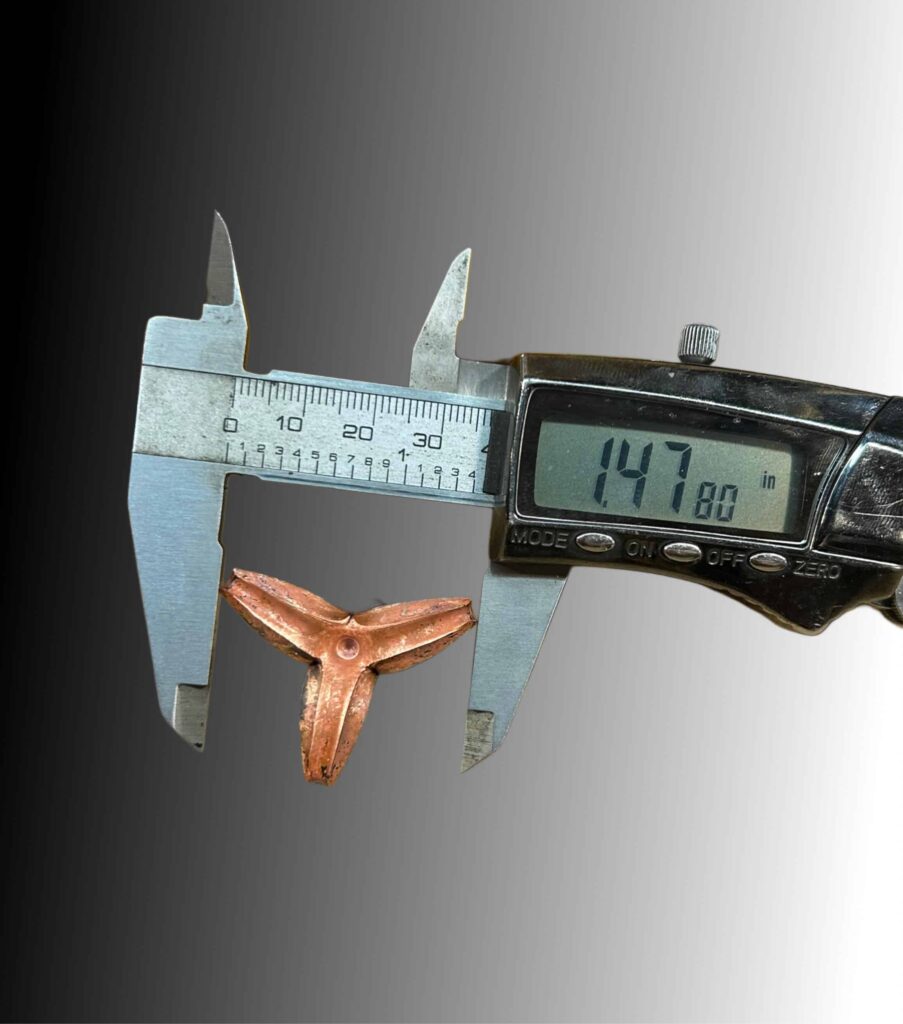
Bullet Weight and Accuracy
How Weight Influences Flight and Stability
Accuracy is influenced by several factors, including barrel twist rate, velocity, bullet design, and consistency of the load. Bullet weight plays into all of these.
Lighter bullets typically:
- Achieve higher muzzle velocities
- Have flatter trajectories at short distances
- Reduce time of flight
However, lighter bullets can be more sensitive to wind drift and may not stabilize optimally in every barrel, especially at longer distances.
Heavier bullets generally:
- Retain velocity better downrange
- Are less affected by wind
- Provide greater stability when paired with the correct twist rate
For many shooters, heavier bullets deliver tighter groups at distance but only when the ammunition is built consistently.
Why Consistency Matters More Than Weight
Two cartridges with identical bullet weights can perform very differently if:
- Powder charges vary
- Seating depth is inconsistent
- Velocity spreads are excessive
At Steinel Ammunition, accuracy is built through repeatability. During production, we routinely measure primer seating depth, overall length, powder charge, crimp diameter, and case dimensions – sometimes as frequently as every 20 rounds. This level of quality control ensures that each round behaves like the last, regardless of bullet weight.
Bullet Weight and Recoil
Understanding Recoil Impulse
Recoil isn’t just about how much force is generated – it’s about how that force is delivered.
- Lighter bullets, driven faster, often produce a sharper, snappier recoil
- Heavier bullets usually create a slower, more rolling recoil impulse
Shooter preference varies, but recoil characteristics can affect:
- Follow-up shot speed
- Shooting comfort
- Long-term consistency during extended sessions
Firearm Function and Reliability
Firearms are designed to operate within specific pressure and recoil windows. Ammunition that’s improperly balanced – even if it’s technically within spec, can lead to:
- Inconsistent cycling
- Excessive wear
- Reduced reliability
This is why Steinel tests ammunition across hundreds of firearms, not just a single test gun. Our goal is to ensure reliable function across a wide variety of platforms, bullet weights, and real-world conditions.
Bullet Weight and Penetration
Penetration Is About Balance, Not Extremes
A common misconception is that heavier bullets always penetrate better. In reality, penetration depends on a balance of:
- Bullet weight
- Velocity
- Bullet construction
- Expansion characteristics
- Consistency of the load
A heavy bullet driven too slowly may fail to expand. A light bullet driven too fast may over-expand or fragment prematurely. Neither outcome is desirable, especially in hunting or self-defense scenarios.
Objective Ballistic Testing Matters
At Steinel Ammunition, penetration and expansion are evaluated using Type A Ordnance Gelatin, calibrated to FBI standards. We do not rely on water jugs, newspaper, or improvised testing materials.
Each gelatin batch is:
- Properly mixed and temperature-controlled
- Calibrated to ensure correct density
- Used to generate meaningful, repeatable data
This ensures that when we select a bullet weight for a specific application, performance is validated not assumed.
Bullet Weight Considerations for Popular U.S. Game
While the physics behind bullet weight apply universally, different animals place different demands on ammunition. In the U.S., hunters most commonly pursue deer, feral hogs, elk, and predators such as coyotes.
Deer (Whitetail & Mule Deer)
Deer are the most widely big game hunting animals in the United States. Ethical performance requires reliable expansion and adequate penetration without unnecessary recoil or over-penetration.
- Bullet weight focus: Mid-range, caliber-appropriate
- Performance priorities: Consistent expansion, accuracy, manageable recoil
- Why weight matters: Extreme bullet weights can compromise energy transfer or shot placement
Steinel deer hunting ammunition is developed using proven bullet weights and tested for both accuracy and terminal performance to support clean, ethical harvests.
Feral Hogs
Feral hogs are increasingly hunted across many regions due to population control needs. Their thick hide and dense shoulder structure demand more from ammunition.
- Bullet weight focus: Mid-to-heavy
- Performance priorities: Penetration and structural integrity
- Why weight matters: Lighter bullets may struggle to reach vital organs on larger hogs
Steinel hog loads are engineered with penetration-first performance in mind, while still maintaining consistent accuracy across practical hunting distances.
Elk
Elk are large, heavy-boned animals that require deep, controlled penetration and reliable performance at distance.
- Bullet weight focus: Heavier-for-caliber
- Performance priorities: Momentum retention and consistent expansion
- Why weight matters: Adequate bullet mass helps maintain effectiveness through muscle and bone
Steinel elk ammunition is designed to balance bullet weight and velocity, ensuring predictable performance without pushing loads beyond their optimal window.
Coyotes and Predator Hunting
Predator hunting often involves variable distances, fast-moving targets, and high shot volume.
- Bullet weight focus: Lighter-for-caliber
- Performance priorities: Accuracy, flatter trajectory, reduced recoil
- Why weight matters: Lighter bullets allow quicker shot placement and easier follow-up shots
Steinel predator ammunition is tuned for consistency and precision, helping hunters maintain confidence shot after shot.
Velocity, Pressure, and Bullet Weight
Bullet weight cannot be separated from velocity and pressure. Any combination of bullet, powder, primer, and case must work together within SAAMI specifications.
At Steinel:
- SAAMI specs are treated as gospel
- Chronographs are used extensively
- Average velocity, standard deviation, and extreme spread are closely monitored
- Pressure barrels are leveraged during load development
We also rely on trusted reference data from industry leaders such as Hornady, Speer, Lyman, Nosler, Alliant, and Hodgdon. Statistical analysis and Six Sigma techniques help ensure conclusions are based on data not assumptions.
Why Steinel Follows Proven Bullet Weights
While it may be tempting to chase extremely light or heavy bullets, Steinel prefers bullet weights that align with each caliber’s original design intent.
This approach:
- Improves reliability across firearms
- Enhances consistency in velocity and pressure
- Produces more predictable terminal performance
Rather than offering “premium” as a special product line, premium is our baseline. The same attention to detail applies whether the ammunition is intended for hunting, self-defense, or target shooting.
Choosing the Right Bullet Weight
Instead of asking, “What’s the fastest or heaviest bullet I can run?”, a better question is:
“What bullet weight performs most consistently and reliably in my firearm for my application?”
Accuracy, recoil, and penetration all improve when bullet weight is selected as part of a balanced, well-tested system not in isolation.
FAQ’s
Q1. Is 62 grain or 55 grain better?
A. Neither is universally better-55gr offers higher velocity and flatter trajectory at short range, while 62gr provides better stability and penetration, especially at distance.
Q2. Are lower grain bullets more accurate?
A. Not always; lighter bullets can be accurate at close range, but accuracy ultimately depends on barrel twist rate, load consistency, and firearm compatibility.
Q3. What is the most accurate 9mm bullet weight?
A. Many shooters find 124gr to offer the best balance of accuracy, recoil control, and reliability across most 9mm pistols.
Q4. Is hollow point ammo less accurate?
A. No,modern hollow point ammunition is highly accurate when properly loaded, often matching or exceeding FMJ accuracy in quality ammunition