
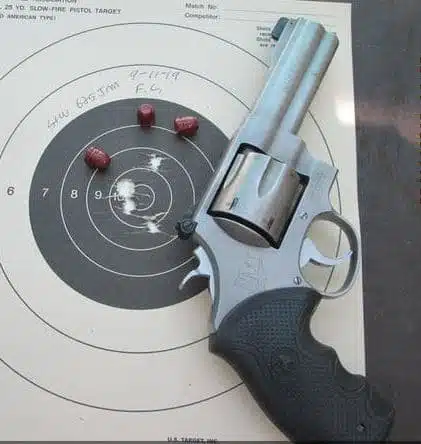
If you’ve spent any time around revolvers or semi-automatic pistols, you’ve likely encountered the terms single action vs double action. For newer shooters, the distinction can seem academic. In practice, it directly affects how your firearm functions, how accurately you can shoot it, and whether it suits the task at hand.
The word “action” in this context refers to what the trigger does mechanically when you pull it. Get that concept right and the rest of the comparison falls into place quickly.
This article breaks down single action vs double action mechanics, compares their trigger characteristics, addresses single action vs double action revolver handling specifically, and helps you determine which is the right fit based on how and what you shoot.
What Is Single Action Revolver ?
How a Single Action Mechanism Works
In a single action firearm, the trigger performs exactly one function: releasing the hammer. Before a shot can be fired, the hammer must be manually cocked – either by hand or, in the case of a semi-automatic, by the rearward travel of the slide after the first round is chambered.
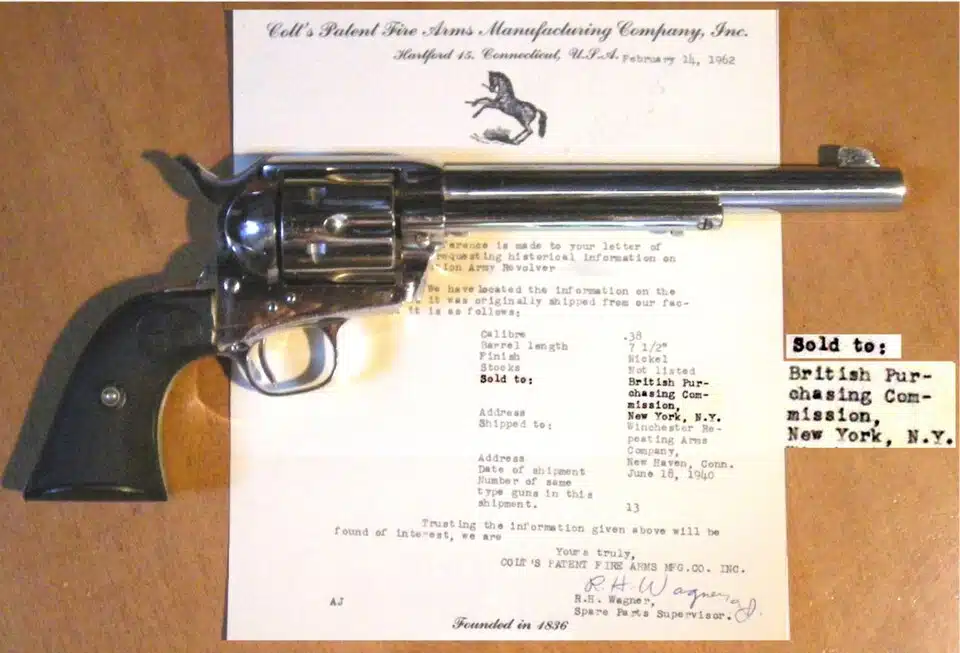
SAA Battle of Britain
Image Source – Wikipedia
No cocking, no shot. That’s the defining constraint of this design.
Key Characteristics
- Light, short trigger pull – typically very crisp and consistent
- Requires a deliberate cocking step before firing
- The shooter has complete control over hammer position before the trigger breaks
Advantages
- Better accuracy potential – a lighter trigger means less hand movement during the break
- Simpler, more predictable trigger feel from shot to shot
- Preferred by target shooters and hunters who take deliberate, aimed shots
Limitations
- Slower to fire in fast-response situations – the hammer must be cocked manually each time in a revolver
- Requires more deliberate handling discipline
- Less forgiving in high-stress or rapid-response scenarios
What Is Double Action Revolver ?
How a Double Action Mechanism Works
In a double action firearm, a single trigger pull completes two mechanical functions: it both cocks the hammer and releases it. No manual cocking is required. This is the core of the double action vs single action distinction – one trigger pull, two mechanical events.
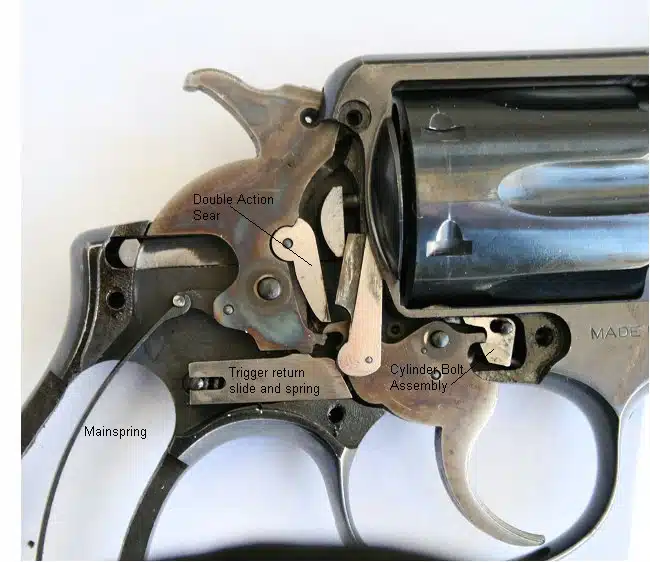
Double Action Revolver – Fifth change lock
Image Source – Wikipedia
Key Characteristics
- Heavier, longer trigger pull – noticeably more resistance than single action
- Faster to deploy – no separate cocking step needed
- More practical for defensive or carry applications
Advantages
- Faster follow-up shots, particularly in defensive applications
- Easier to deploy quickly under stress – no pre-cocking required
- Preferred for personal defense, law enforcement, and rapid-response scenarios
Limitations
- The heavier trigger pull can affect precision, particularly at distance
- Requires more trigger finger strength and control
- Less ideal for precision or long-range work where trigger movement is critical
Single Action vs Double Action: Key Differences
The following table summarizes the primary differences in the single action vs double action comparison:
| Factor | Single Action | Double Action |
| Trigger Function | Releases hammer only (one action) | Cocks and releases hammer (two actions) |
| Trigger Pull | Light and crisp | Heavier – notably more resistance |
| Accuracy Potential | Higher – less trigger disturbance | Moderate – heavier pull can affect aim |
| Speed | Slower – manual cocking required | Faster – no separate cocking step |
| Ease of Use | Moderate – requires deliberate handling | Easier – streamlined operation |
| Best For | Precision shooting, range work, hunting | Defensive use, fast follow-up scenarios |
What do these differences mean in practice:
- A light trigger in single action translates to less finger movement during the break, which typically produces more consistent shot placement – particularly at distance.
- The heavier double action pull takes more finger travel before the shot breaks. Under controlled conditions, experienced shooters manage it well. Under stress or at longer range, it introduces more variables.
- For hunting applications where shots are deliberate, single action typically offers a practical edge. For defensive use, double action’s speed advantage is meaningful.
Single Action vs Double Action Trigger: What’s the Real Difference?
The single action vs double action trigger distinction comes down to weight, travel, and consistency.
A single action trigger typically breaks cleanly at a fraction of the force required by double action. That difference matters when you’re trying to hold a precise sight picture. A lighter break allows the shooter to fire without disturbing the aim nearly as much.
Double action triggers require the shooter to apply continuous pressure through a longer arc of travel. Skilled shooters learn to manage this, but it takes more practice to achieve the same level of precision. The tradeoff is speed – the firearm is always ready to fire without any pre-cocking.
Trigger weight also affects fatigue during extended range sessions. A heavier pull, repeated over many shots, increases finger fatigue. For target shooting or practice where volume matters, single action is typically the more comfortable choice over time.
With heavy-recoiling cartridges like .44 Magnum or .45-70 Government, trigger control becomes even more important. A light, crisp break supports proper grip and follow-through in ways a heavy pull does not.
Single Action vs Double Action Revolver: What Sets Them Apart?
The single action vs double action revolver comparison has its own nuances beyond just the trigger mechanism.
Traditional single action revolvers – the type associated with classic American frontier firearms – require the shooter to manually thumb back the hammer before each shot. Cylinders on many classic designs must be loaded one round at a time through a loading gate. This is deliberate, methodical shooting.
Modern double action revolvers allow the shooter to either pre-cock the hammer for a lighter pull (effectively using single action mode) or pull through the full double action trigger for a faster, uncocked shot. This versatility is one reason the double action revolver became standard for law enforcement through much of the 20th century.
Handling differences are real and noticeable:
- Single action revolvers reward careful, deliberate shooters. The ergonomics – particularly the grip angle on classic designs are well-suited to aimed fire.
- Double action revolvers are faster to deploy, easier to operate under stress, and more forgiving of the varying grip conditions that arise in field use.
Revolver cartridges like the .44 Magnum are chambered in both action types. The cartridge itself doesn’t change, but the platform and trigger characteristics affect how effectively most shooters can deliver it on target.
Accuracy: Which One Performs Better?
Single action is generally regarded as the more accurate option for deliberate, aimed shooting. The mechanical reason is straightforward: less trigger resistance means less hand movement during the break, which translates to less sight disturbance.
That said, accuracy is ultimately shooter-dependent. An experienced shooter who has put significant time into double action trigger control can achieve excellent precision. The double action trigger does not prevent accurate shooting – it simply demands more skill and practice to reach equivalent results.
Distance amplifies the difference. At close range, either action type is accurate enough for most applications. As distance increases, the precision advantages of single action become more apparent. For hunting applications – where shot placement directly determines outcome, this matters.
When shooting cartridges like the 458 SOCOM, precision is not optional. These cartridges are capable of ethical harvests at reasonable hunting distances, but that outcome depends on controlled, accurate shot placement. A lighter, more consistent trigger supports that goal.
Real-World Use Cases
The right action type depends on the context. Neither is universally superior.
Controlled Shooting Scenarios
Target shooting, hunting, and precision range work generally favor single action. In these contexts, the shooter has time to cock the hammer, establish a proper sight picture, and break a clean shot. The lighter trigger works in the shooter’s favor.
Handgun hunters using cartridges such as 44 Magnum for deer or hogs benefit from single action mechanics when taking shots at distance. The combination of a powerful, reliable cartridge and a clean trigger break gives the shooter the best opportunity for an effective, ethical shot.
Quick-Response Situations
Defensive applications – home defense, concealed carry, or situations where the firearm may be deployed under stress, generally favor double action. The ability to fire without pre-cocking eliminates a mechanical step during a scenario where speed and simplicity matter.
Double action also carries a safety advantage in some respects. The heavier pull makes an unintentional discharge less likely than with a very light single action trigger. For everyday carry or home defense, that characteristic has value.
Which One Should You Choose?
The answer depends on three factors: your experience level, how familiar you are with your trigger, and what you intend to do with the firearm.
- If you are newer to shooting and prioritize ease of use and faster deployment, double action is the more practical starting point. Less manual manipulation required means one fewer thing to manage during use.
- If you have experience and are focused on accuracy – whether for target shooting, hunting, or precision practice – single action gives you a mechanical advantage. You’ll need the discipline to keep the hammer cocked safely, but the trigger payoff is real.
- If your revolver offers both options (most modern double action revolvers do), practice with both. Many experienced shooters default to pre-cocking the hammer for aimed fire and use double action only when speed is the priority.
For hunting applications, particularly with powerful revolver cartridges like the .44 Magnum or the 45-70 Government, single action is typically the preferred mode. The cartridges are capable – the limiting factor is shot placement, and a clean trigger break supports that.
Final Thoughts
The single action vs double action comparison is not about which is objectively better. It’s about which fits the task.
Single action offers a lighter trigger, more consistent break, and better accuracy potential for deliberate shooting. Double action trades some of that precision for speed and ease of deployment.
For single action vs double action revolver questions specifically: both platforms are reliable and capable when paired with quality ammunition. The traditional single action revolver rewards patient, skilled shooting. The modern double action revolver handles more real-world conditions with less manual input.
Know your context, choose accordingly, and practice with whichever you carry or hunt with. The mechanical advantage only matters when it’s paired with genuine trigger discipline.
At Steinel Ammo, we load premium ammunition for both single-action and double-action revolvers – from classic .45 Colt and .44 Magnum loads for traditional single-action guns to modern defensive and hunting loads for double-action revolvers.
Still not sure which type of revolver or trigger system fits your needs best? Call us at (330) 840-7086. We’ll help you choose the right setup for you.
Because your legacy deserves better than a guess