
A sniper rifle defines the platform, but the cartridge defines performance. True precision comes from consistent accuracy, reliable ballistics, and dependable terminal performance when every shot counts.
From Stalingrad to today’s precision rifle competition, certain cartridges have proven themselves through decades of documented use. This isn’t about Hollywood mythology. It’s about the calibers that serious marksmen have relied on, the history that earned them that trust, and what makes them relevant to collectors and precision shooters today.
Sniper Calibers of the WWII Era
WWII sniper systems were built around bolt-action rifles that prioritized deliberate, precise shooting over volume of fire. Optics were limited, typically 2.5 to 4 power. Conditions were unforgiving. The cartridge had to perform identically every time: in extreme cold, in mud, after days without maintenance. Four cartridges defined this era.
7.62×54R – The Eastern Front Standard
Introduced by the Russian Empire in 1891 alongside the Mosin–Nagant, the 7.62×54R is one of the few rimmed bottleneck cartridges still in active military service today, over 130 years later. As a WWII sniper cartridge, it reached its defining form in the Mosin–Nagant 91/30 PU: only rifles that demonstrated above-average factory accuracy were pulled for sniper conversion, fitted with a bent bolt handle and a fixed 3.5-power PU scope graduated from 0 to 1,300 meters.
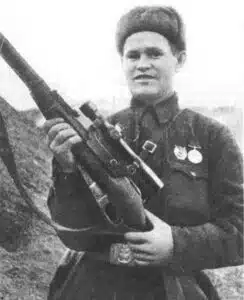 Vasily G. Zaitsev with his sniper rifle
Image source: Stalingrad Front
That scope imposed real limitations. Its low magnification required shooters to compensate through skill rather than glass. The snipers who mastered it were exceptional. Vasily Zaitsev is credited with over 200 confirmed kills at Stalingrad. Lyudmila Pavlichenko achieved 309 confirmed kills before being wounded and withdrawn in 1942. Finland’s Simo Häyhä – using the cartridge without a scope in the Winter War is credited with 505 confirmed kills.
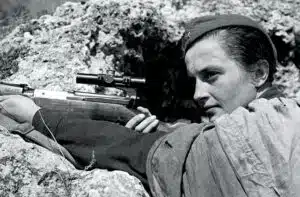 History Today / © Ozersky/AFP/Getty
The cartridge remains in active Russian military service today, chambered in the SVD Dragunov and SV-98 sniper rifles.
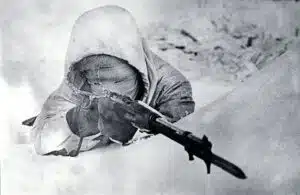
Finnish sniper Simo Häyhä, known as the “White Death” tracks a target over the open sights of his Mosin-Nagant rifle.
Image Source: Warfare History Networt
.30-06 Springfield – The American Standard
The .30-06 Springfield powered the primary American sniper platforms of WWII. The M1903A4, standardized January 14, 1943, with approximately 28,000 produced by Remington, was fitted with a 2.75-power Weaver scope with an effective range of around 600 yards. Iron sights were omitted entirely, a controversial decision given how fragile and fog-prone the era’s glass was under field conditions.
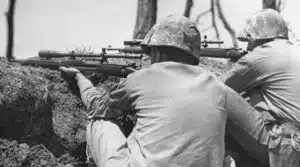
There are two Marine M1903 rifles fitted with Unertl riflescopes in this photo from Okinawa in May 1945.
Source: American Rifleman[
The M1903A4 served across every theater: North Africa, Sicily, Italy, Normandy, the Hurtgen Forest, and the Pacific. The U.S. Marine Corps took a different approach – armorers selected M1903A1 rifles and fitted them with 8-power Unertl target scopes, producing a more capable precision system with documented hits beyond 1,000 yards. The M1C Garand was adopted in June 1944 as a parallel development alongside the M1903A4 – not a direct replacement; the M1903A4 continued in service well past the war. Fewer than 8,000 M1C rifles reached the troops before V-J Day.
Browse Steinel .30-06 Springfield
.303 British – The Commonwealth Precision Standard
The .303 British equipped British and Commonwealth sniper units in WWII through the Lee-Enfield No. 4 Mk I(T) – a hand-selected, scope-fitted variant introduced in 1941, with over 24,000 produced. The No. 32 telescopic sight ran at 3.5 power. The rifle’s 174-grain Mk VII bullet at approximately 2,440–2,500 fps offered significant penetration; British Army small arms documentation of the era recorded the Mk VII as capable of penetrating 14 inches of mortared brickwork at 200 yards — a figure that reflects both the cartridge’s energy and the hardness of the Mk VII’s steel-and-aluminum composite core, which resisted deformation on hard targets.
No. 4 Mk I(T) snipers served across North Africa, Italy, Northwest Europe after D-Day, and the Pacific. The .303 continued in Commonwealth sniper use through the Korean War.
7.5×55 Swiss – Precision as Deterrence
The 7.5×55 Swiss achieved something no other WWII cartridge can claim: its greatest contribution was preventing a battle from happening. Switzerland was surrounded by German-occupied Europe and Fascist Italy, and Hitler’s planners evaluated invasion repeatedly. One factor cited in Swiss deterrence was the K31 Schmidt-Rubin rifle – a straight-pull bolt-action that routinely shot one-inch groups at 100 yards from factory iron sights, loaded with the GP11 service cartridge: a 174-grain load at 2,650 fps with near-match consistency. Every Swiss infantryman in a mountain position was a potential 400-yard marksman.
The 7.5×55’s ballistics are nearly identical to .308 Winchester, which is why it remains a competitive choice in vintage military rifle shooting today. Note: Switzerland’s dedicated semi-automatic sniper platform, the ZfK-55, was adopted in 1955 – post-WWII and is one of the earliest purpose-built semi-automatic sniper rifles adopted by any military.
Modern Precision Calibers
Modern precision cartridges build on WWII foundations with improved bullet design, tighter manufacturing tolerances, and more consistent propellant technology. The objective is unchanged: place the shot exactly where intended, shot after shot. The tools have evolved; the physics haven’t.
.308 Winchester – The Modern Benchmark
Introduced commercially in 1952, the .308 Winchester became the foundation of American military sniping: the M24, M40 series, and the Remington 700 are all .308 platforms. A 168-grain Sierra MatchKing at 2,600 fps from a 24-inch barrel is the reference load against which most other precision cartridges are measured. Manageable recoil, broad ammunition availability, and proven performance to 800 yards make it the most versatile precision cartridge in production.
Browse Steinel .308 Winchester
.300 WSM – Extended Range Performance
The .300 WSM generates magnum-class velocity in a short-action platform – its defining logistical advantage over the full-length .300 Winchester Magnum, which requires a longer, heavier action and stock. A 190-grain load at approximately 2,800 fps extends practical precision range beyond the .308 Winchester envelope, making it the practical choice when consistent shots beyond 600 yards are expected or when conditions demand additional energy at distance.
.223 Remington / 5.56 NATO – Precision Through Control
Best understood in a precision context as a training and competition cartridge. Low recoil, high volume, and affordability make it ideal for building fundamentals at distances where its ballistics are effective. In military use, the Mk 12 Special Purpose Rifle used 77-grain open-tip match bullets to achieve reliable precision at distances the standard M855 load could not. A legitimate precision tool within its effective range; not a substitute for the larger cartridges at extended distance.
A Note on 6.5 Creedmoor
Readers familiar with modern precision shooting will notice the 6.5 Creedmoor is not listed among the modern calibers above. This is a deliberate scope decision, not an omission. This article focuses on cartridges with documented military sniper history – WWII through present. The 6.5 Creedmoor is a genuinely excellent modern precision cartridge with a strong competition track record and growing military adoption. Its absence here reflects the article’s historical focus, not a judgment on its ballistic merit.
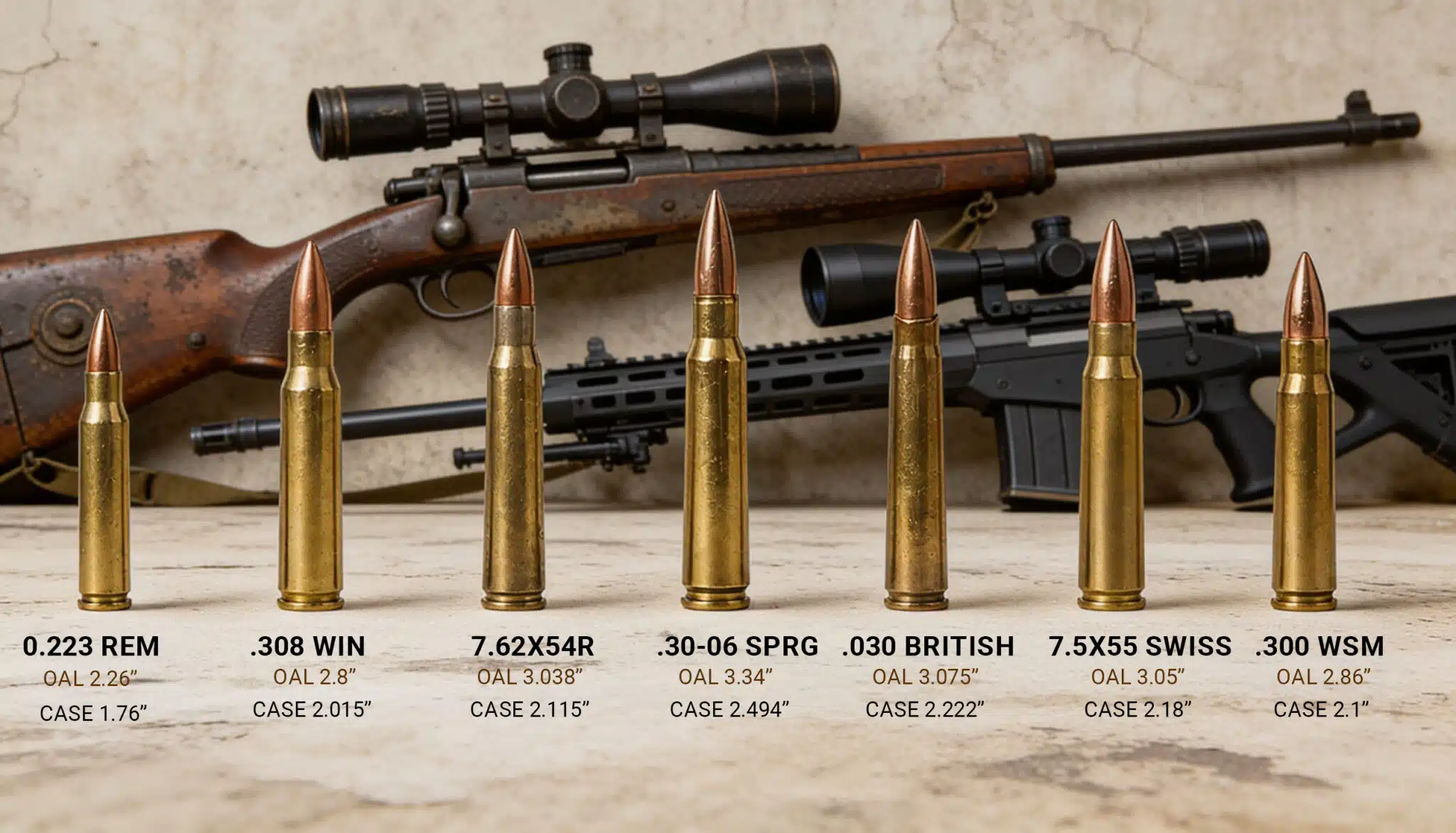
Cartridge Scale Comparison
The illustration below shows all seven cartridges proportional to their actual Overall Cartridge Length (OAL). The .30-06 Springfield’s additional case length over the .303 British and 7.5×55 Swiss is clearly visible, as is the .300 WSM’s wider base diameter relative to the .308 Winchester and other cartridges of comparable length.
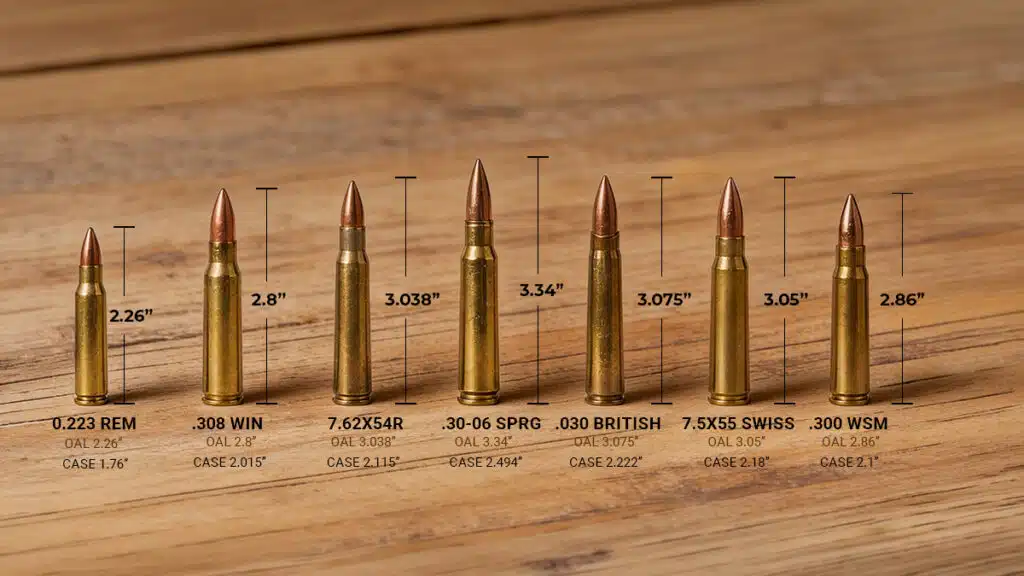
Cartridge dimensions proportional to OAL. Case taper and shoulder geometry are simplified for illustration. Source dimensions from SAAMI specifications.
| Cartridge | Era | OAL | Case Length | Bullet Wt. | Approx. Velocity | Rim Dia. | Primary Platform |
| 7.62×54R | 1891–present | 3.038″ | 2.115″ | 147–182 gr | ~2,550–2,850 fps | 0.566″ | Mosin–Nagant 91/30 PU; SVD Dragunov |
| .30-06 Springfield | 1906–present | 3.340″ | 2.494″ | 150–220 gr | ~2,500–2,950 fps | 0.473″ | M1903A4; M1C/M1D Garand |
| .303 British | 1889–present | 3.075″ | 2.222″ | 174 gr Mk VII | ~2,350–2,550 fps | 0.540″ | Lee-Enfield No.4 Mk I(T) |
| 7.5×55 Swiss | 1911–present | 3.050″ | 2.180″ | 174 gr GP11 | ~2,600–2,700 fps | 0.498″ | K31 Schmidt-Rubin; ZfK-55 (post-1955) |
| .308 Winchester | 1952–present | 2.800″ | 2.015″ | 168–175 gr | ~2,550–2,700 fps | 0.473″ | M24 SWS; M40; Remington 700 |
| .300 WSM | 2001–present | 2.860″ | 2.100″ | 180–220 gr | ~2,750–2,950 fps | 0.535″ | Custom bolt-actions; Browning X-Bolt |
| .223 Rem / 5.56 | 1964–present | 2.260″ | 1.760″ | 55–77 gr | ~2,650–3,250 fps | 0.378″ | AR-15 platforms; Mk12 SPR |
*Velocities vary by barrel length, bullet weight, chamber dimensions, and specific load data.
Why Ammunition Quality Matters in Precision Shooting
Consistency in powder charge, bullet seating, case dimensions, and primer ignition determines whether round fifty performs identically to round one. In 1943, a Soviet sniper in Stalingrad had one shot and a 3.5-power scope. Today, a precision shooter at 700 yards is running a firing solution with seconds to execute. In both cases, the round in the chamber needs to do exactly what the previous round did.
At Steinel Ammo, every round is produced with consistent powder charges, proper bullet seating, and dimensional controls that deliver repeatable performance across the full run. For the WWII cartridges, that means honoring each cartridge’s engineering tradition with modern components. For the modern calibers, it means ammunition a serious shooter can trust when it matters.
Browse the full Steinel Ammo catalog here
Frequently Asked Questions
Q1. What caliber is most commonly used for precision shooting today?
.308 Winchester / 7.62×51mm NATO. It anchors military sniper programs across NATO, remains highly influential in precision rifle competition, and offers the broadest ammunition and platform support of any precision cartridge.
Q2. Are WWII sniper calibers still relevant today?
Yes. The 7.62×54R never left military service – it is chambered in Russian sniper rifles today. The .30-06 remains a competitive hunting and precision cartridge. The .303 British and 7.5×55 Swiss are genuine performers in vintage military rifle competition. None became obsolete; they were superseded for specific military logistics reasons, not because their ballistics failed.
Q3. What matters more – rifle or ammunition?
Both are essential, but ammunition consistency is foundational. A rifle that shoots 0.5 MOA with match ammunition is being held back by inconsistent loads, not limited by its mechanical capability. The precision ceiling is set by the cartridge. The rifle determines whether you reach it.
Q4. Is .223 suitable for precision shooting?
Yes, within its effective range. With 77-grain match bullets from a 1:8 twist barrel, it is capable of genuine precision to 600 yards. For training purposes, it is the most practical precision cartridge available. It is not a substitute for the larger cartridges at extended distance.
Not sure which precision caliber fits your rifle or application? Call us at (330) 840-7086. We’ll walk you through exactly what to run for your platform and your shooting goals.
Because your legacy deserves better than a guess.