The bolt action rifle has played a major role in firearm development for nearly two centuries. From 19th-century military rifles to modern hunting and target-shooting platforms, its manually operated mechanism remains one of the most recognizable firearm designs.
But what exactly is a bolt action rifle, and why has the design remained relevant despite the development of semiautomatic firearms?
The answer lies in its mechanical simplicity, strong locking systems, and adaptability to many different cartridges. Bolt-action firearms have been chambered for everything from the small .22 Long Rifle rimfire cartridge to full-power centerfire rifle ammunition.
Understanding bolt-action rifles also means understanding the cartridges associated with them. A 308 bolt action rifle, for example, belongs to a very different cartridge class than a 22 bolt action rifle, even though both use a manually operated bolt.
This guide explains the history of bolt-action rifles, their basic operating principles, important mechanical characteristics, and common chamberings, including .22 LR, .308 Winchester, .300 Blackout, 8.6 Blackout, .22 ARC, 5.56 NATO, and 9mm Luger.
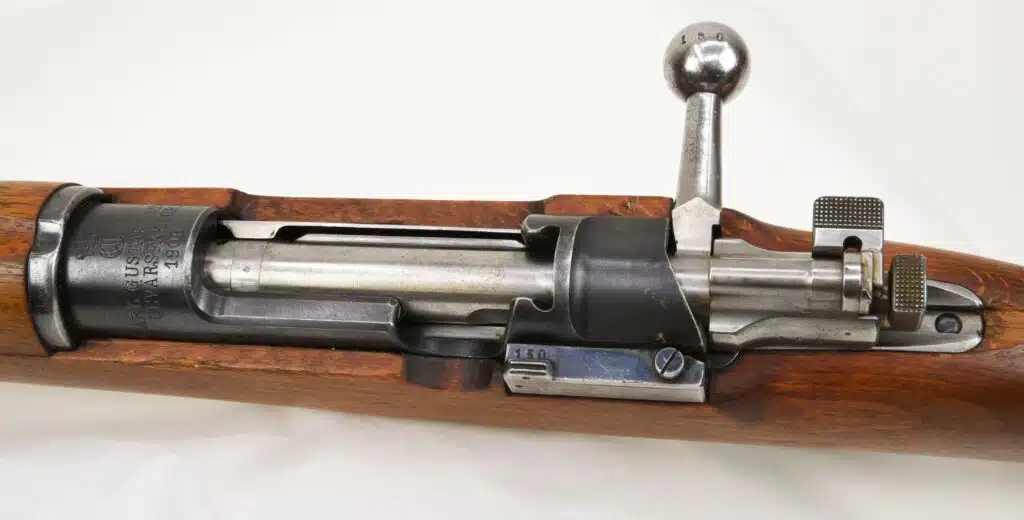
Bolt action rotating bolt in Mauser m/96
Source-Wikipedia
What Is a Bolt Action Rifle?
A bolt action rifle is a firearm that uses a manually operated bolt to open and close the chamber, secure a cartridge for firing, and extract the cartridge case afterward.
In a conventional turn-bolt design, the bolt moves longitudinally within the receiver and uses locking lugs to secure the action when closed.
Unlike a semiautomatic rifle, which automatically cycles its action after firing, a traditional bolt-action rifle requires manual operation between shots.
The bolt-action system is commonly associated with hunting rifles, precision target rifles, military surplus firearms, and recreational rimfire rifles.
Quick Answer: A bolt-action rifle is a manually operated firearm in which a movable bolt controls the chambering, locking, extraction, and ejection of cartridges. Its design has remained popular because it can accommodate a wide variety of firearm configurations and cartridge types.
How Does a Bolt Action Rifle Work?
A typical bolt-action rifle consists of several interconnected mechanical components, including the bolt, receiver, barrel, chamber, locking lugs, extractor, ejector, and firing mechanism.
Although individual models differ, these components perform several fundamental functions.
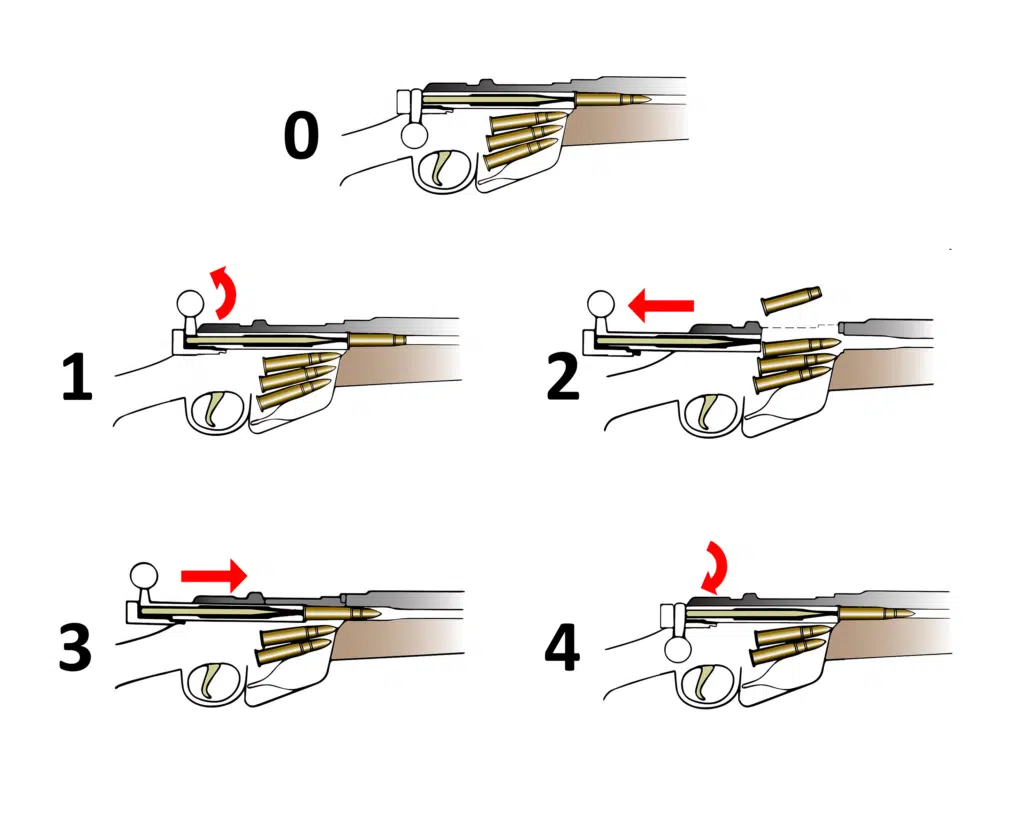
Rotating bolt scheme
Source-Wikipedia
1. The Bolt and Receiver
The bolt is a movable metal assembly housed within the receiver.
In a traditional turn-bolt rifle, a rotating bolt handle is connected to the mechanism that locks and unlocks the action.
The receiver supports the bolt assembly and connects it to the firearm’s barrel and other major components.
2. The Chamber and Locking System
The chamber is the section of the barrel designed to accommodate a particular cartridge.
When the bolt is locked, its locking surfaces help contain the forces generated during firing.
Different rifle manufacturers use different locking-lug arrangements, bolt throws, and receiver configurations.
3. Cartridge Extraction and Ejection
Bolt-action rifles contain components that remove a cartridge case from the chamber and eject it from the firearm.
The extractor engages the cartridge case, while the ejector helps move it out of the action.
These components vary between rifle designs. For example, controlled-round-feed and push-feed actions use different approaches to cartridge control and extraction.
4. The Firing Mechanism
Most modern bolt-action rifles use an internal firing pin or striker mechanism.
The firing mechanism is designed to initiate the cartridge’s primer when the firearm is discharged.
While the basic purpose remains consistent, firing-pin assemblies and safety systems vary significantly across historical and modern designs.
When Was the First Bolt Action Rifle Invented?
The history of the first bolt action rifle begins in the early 19th century with German gunsmith Johann Nikolaus von Dreyse.
Dreyse experimented with needle-fired firearms during the 1820s and developed a practical bolt-action breechloading design in the 1830s.
His Dreyse Needle Gun, patented in 1836, was adopted by the Prussian military in 1840 and introduced into service as the Model 1841.
Unlike traditional muzzleloading muskets, the Dreyse rifle used a breechloading mechanism and a self-contained combustible paper cartridge.
Its needle-like firing pin passed through the cartridge’s powder charge to reach the primer.
The design represented a significant advancement in military firearm technology, although the firing needle was vulnerable to wear and damage.
How Bolt-Action Rifles Evolved
| Year | Historical development | Significance |
| 1836 | Dreyse Needle Gun patented | Early practical bolt-action breechloader |
| 1841 | Dreyse Model 1841 entered Prussian service | Important military adoption |
| 1871 | Mauser Model 1871 | Early metallic-cartridge bolt-action service rifle |
| 1886 | French Lebel Model 1886 | Early smokeless-powder military bolt-action rifle |
| 1891 | Mosin-Nagant adopted | Influential military bolt-action design |
| 1898 | Mauser Model 1898 | Major development in bolt-action design |
| 1903 | U.S. Model 1903 Springfield | Important American military bolt-action rifle |
During the late 19th and early 20th centuries, bolt-action rifles became standard infantry weapons across much of the world.
The Mauser, Lee-Enfield, Mosin-Nagant, and Springfield rifle families helped establish the design’s reputation for durability and reliability.
Although semiautomatic and automatic firearms later replaced bolt-action rifles as standard infantry weapons in many countries, bolt-action mechanisms continued to evolve for sporting, hunting, and precision applications.
Related reading: What Were the Most Used WWII Rifles?
Common Bolt Action Rifle Calibers Explained
Bolt-action rifles are available in a remarkably broad selection of chamberings.
The term caliber usually describes the nominal diameter of a firearm’s bore or projectile. However, in everyday usage, people frequently use it to refer to a complete cartridge designation.
That distinction matters because cartridges with similar bullet diameters may have very different dimensions and operating characteristics.
Here is an overview of several common and specialized bolt-action rifle chamberings.
| Cartridge | Cartridge type | General characteristics |
| .22 Long Rifle | Rimfire | Small-caliber recreational and target cartridge |
| .308 Winchester | Centerfire | Established sporting and precision rifle cartridge |
| .300 AAC Blackout | Centerfire | Compact .30-caliber rifle cartridge |
| 8.6 Blackout | Centerfire | Modern .338-caliber cartridge |
| .22 ARC | Centerfire | Modern .224-caliber rifle cartridge |
| 5.56×45mm NATO | Centerfire | Military-standardized small-caliber rifle cartridge |
| 9mm Luger | Centerfire | Primarily a handgun cartridge, with limited bolt-action applications |
1. 22 Bolt Action Rifle: A Classic Rimfire Platform
A 22 bolt action rifle is generally chambered in .22 Long Rifle, one of the world’s most established rimfire cartridges.
The .22 LR cartridge was introduced in 1887 and has been widely associated with recreational shooting, target competitions, and small-game hunting.
Unlike centerfire ammunition, rimfire cartridges contain priming compound within the rim of the cartridge case.
Common examples of .22 LR bolt-action rifles include the CZ 457, Ruger American Rimfire, and Savage Mark II.
These rifles demonstrate that bolt-action designs are not limited to high-powered centerfire cartridges.
It is also important to distinguish .22 LR from other .22-caliber cartridges, including .22 WMR, .223 Remington, and .22 ARC. Despite similar nominal bullet diameters, these cartridges are not interchangeable.
2. 308 Bolt Action Rifle: An Established Centerfire Chambering
The 308 bolt action rifle represents one of the most recognizable combinations in modern sporting and precision firearms.
Introduced commercially in 1952, the .308 Winchester cartridge became widely established in hunting and competitive shooting.
It is a bottlenecked centerfire cartridge with a nominal .308-inch bullet diameter.
Examples of rifles produced in .308 Winchester include the Remington Model 700, Winchester Model 70, and Ruger American.
The cartridge is also closely related historically to the military 7.62×51mm NATO cartridge, although differences in specifications and firearm chambers mean compatibility should never be assumed without manufacturer confirmation.
The .308 Winchester has appeared in numerous bolt-action platforms over several decades, making it an important part of modern rifle history.
3. 300 Blackout Bolt Action Rifle: A Modern .30-Caliber Combination
The 300 Blackout bolt action rifle combines a manually operated action with the .300 AAC Blackout cartridge.
Introduced in the early 2010s, .300 Blackout was developed as a compact .30-caliber cartridge compatible with the general dimensions of the AR-15 platform.
Although it is strongly associated with semiautomatic firearms, the cartridge also appears in bolt-action rifles.
Examples include certain configurations of the Ruger American Ranch and CZ 600 Trail.
One defining characteristic of .300 Blackout is the availability of ammunition with widely different bullet weights and ballistic characteristics.
The cartridge has attracted attention for its use in compact rifle platforms, but it should not be confused with .308 Winchester simply because both use .30-caliber projectiles.
Their case dimensions, overall cartridge specifications, and chamber requirements are different.
4. 8.6 Blackout Bolt Action Rifle: A Newer Specialty Cartridge
The 8.6 Blackout bolt action rifle belongs to a newer category of specialized centerfire firearms.
The 8.6 Blackout cartridge was developed by Q and uses a projectile with a nominal diameter of .338 inches.
Although its name resembles .300 Blackout, it is a substantially different cartridge with distinct dimensions and specifications.
Modern bolt-action firearms chambered in 8.6 Blackout include the B&T SPR86.
The cartridge is associated with modern specialty rifle development and demonstrates how manufacturers continue to introduce new chamberings for manually operated rifle platforms.
It is not interchangeable with .300 Blackout or other cartridges simply because they share the Blackout name.
5. .22 ARC Bolt Action Rifle: A Modern Centerfire Cartridge
The 22 ARC bolt action rifle represents another example of modern cartridge development.
Introduced by Hornady in 2023 as part of its 2024 product lineup, the .22 ARC (Advanced Rifle Cartridge) is designed around modern .224-caliber projectiles.
The cartridge was developed for compatibility with the AR-15 platform, but Hornady also identifies bolt-action rifles as suitable platforms for the chambering.
Although both .22 ARC and .22 LR contain “.22” in their names, the similarities should not be confused with cartridge compatibility.
The .22 LR is a rimfire cartridge, while .22 ARC is a substantially larger bottlenecked centerfire cartridge.
Their dimensions, ignition systems, and intended firearm designs are fundamentally different.
6. 5.56 Bolt Action Rifle: Understanding a Military-Standard Cartridge
A 5.56 bolt action rifle is a manually operated firearm specifically chambered for 5.56×45mm NATO.
The cartridge became established as a standardized military rifle cartridge during the second half of the 20th century.
While 5.56 NATO is strongly associated with semiautomatic and select-fire rifle platforms, manually operated rifles are also available with compatible chamberings.
An important distinction exists between 5.56 NATO and the closely related .223 Remington.
Although they have similar external dimensions, the chamber specifications and ammunition pressure standards are not identical.
For that reason, a rifle marked .223 Remington should not automatically be assumed compatible with 5.56 NATO ammunition.
The exact firearm manufacturer’s specifications remain the appropriate reference.
6. 9mm Bolt Action Rifle: An Uncommon Pistol-Caliber Design
A 9mm bolt action rifle is considerably less common than a bolt-action firearm chambered for .22 LR, .308 Winchester, or other established rifle cartridges.
The 9mm Luger cartridge was introduced in 1902 and became widely associated with semiautomatic handguns and pistol-caliber carbines.
Nevertheless, unusual bolt-action firearms chambered in 9mm have existed.
One historical example is an experimental 9mm version of the British De Lisle carbine developed during World War II. The better-known production De Lisle used .45 ACP instead.
Modern 9mm bolt-action firearms remain niche products rather than a mainstream sporting rifle category.
This distinction illustrates how firearm action types and cartridge classifications are separate considerations. A cartridge typically associated with handguns can also appear in specially designed manually operated firearms.
Bolt Action vs. Lever Action vs. Semiautomatic Rifles
Although these firearms may share certain external characteristics, their operating systems are different.
| Feature | Bolt action | Lever action | Semiautomatic |
| Operating mechanism | Manually operated bolt | Manually operated lever | Self-cycling action |
| Action cycling | Manual between shots | Manual between shots | Automatic after firing |
| Common magazine formats | Fixed or detachable | Tubular, fixed, or detachable | Usually detachable or fixed |
| Typical examples | Remington 700, CZ 457 | Winchester 1894, Marlin 336 | Ruger 10/22, AR-15 |
| Historical association | Military and sporting rifles | Repeating rifles of the American frontier | Modern military and sporting firearms |
Neither bolt-action nor lever-action construction determines a rifle’s caliber.
The chambering depends on the specific firearm design and the cartridge specifications established by its manufacturer.
Why Are Bolt Action Rifles Still Popular?
Despite the development of modern semiautomatic rifles, manually operated bolt-action firearms remain common in several shooting disciplines.
Their continued popularity reflects several characteristics of the design.
Mechanical Simplicity
Traditional bolt-action rifles contain fewer automatic cycling components than many self-loading designs.
This can make their operating principles straightforward to understand, although the complexity of individual firearms varies.
Accuracy and Precision
Bolt-action rifles have a long-established presence in precision shooting.
The action’s locking system and relatively straightforward mechanical layout can provide a stable foundation for accurate rifle designs.
However, action type alone does not determine accuracy. Barrel quality, ammunition consistency, chamber dimensions, and overall manufacturing quality also matter.
Wide Cartridge Selection
Bolt-action platforms are manufactured for many different cartridge classes, including rimfire ammunition, conventional centerfire rifle cartridges, and newer specialty chamberings.
This versatility has helped the design remain relevant across different generations of sporting firearms.
Long Service History
From the Dreyse Needle Gun to the Mauser 98 and modern sporting rifles, bolt-action designs have undergone continual refinement.
Their continued production reflects a combination of historical significance and established practical applications.
Understanding Ammunition Compatibility in Bolt Action Rifles
The cartridge designation is one of the most important specifications associated with any rifle.
For example, .22 LR and .22 ARC are different cartridges despite sharing a similar nominal caliber designation.
Likewise, .300 Blackout, .308 Winchester, and 8.6 Blackout are separate chamberings with different dimensions and specifications.
Even cartridges with closely related names or dimensions should not automatically be treated as interchangeable.
For historical firearms, ammunition identification can be particularly complex because manufacturers may have produced different chamberings under the same model family.
Ammunition compatibility should always be confirmed using the firearm’s markings, manufacturer’s documentation, and qualified professional guidance when necessary.
This connection between firearm design and cartridge specifications is especially relevant to Steinel Ammunition Co. interest in both modern and historical ammunition.
Frequently Asked Questions
Q1. When was the first bolt action rifle made?
The first practical bolt-action rifle was developed by Johann Nikolaus von Dreyse in 1836. Known as the Dreyse Needle Gun, it was adopted by the Prussian military in 1840.
Q2. Are bolt action rifles more accurate?
Bolt-action rifles are often associated with high accuracy because of their rigid locking mechanisms and consistent operation. However, accuracy also depends on barrel quality, ammunition, rifle design, and shooting conditions.
Q3. How to load a bolt action rifle?
Bolt-action rifles are loaded using a magazine or directly through the action, depending on the model. Always follow the manufacturer’s instructions, use the correct ammunition, and observe firearm safety precautions.
Q4. What is a high-powered bolt action rifle?
A high-powered bolt-action rifle is generally a centerfire rifle chambered for a full-power rifle cartridge, such as .308 Winchester, .30-06 Springfield, or .300 Winchester Magnum. These rifles are commonly associated with hunting and long-range target shooting.
Final Thoughts
The bolt action rifle remains one of the most influential firearm designs in history.
Beginning with early 19th-century innovations such as the Dreyse Needle Gun, the mechanism evolved through military service and continued into modern sporting rifle development.
Today’s bolt-action platforms cover a broad variety of cartridges, ranging from .22 LR to .308 Winchester and newer chamberings such as .300 Blackout, 8.6 Blackout, and .22 ARC.
Understanding their history, mechanical differences, and ammunition specifications provides a clearer picture of why bolt-action rifles continue to occupy an important place in firearm design.
At Steinel Ammunition Co., the same attention to cartridge history and technical specifications informs our educational resources covering classic, modern, and hard-to-find ammunition.
Explore the Steinel Ammunition Blog to learn more about cartridge development, historical firearms, and the technical differences between ammunition types.