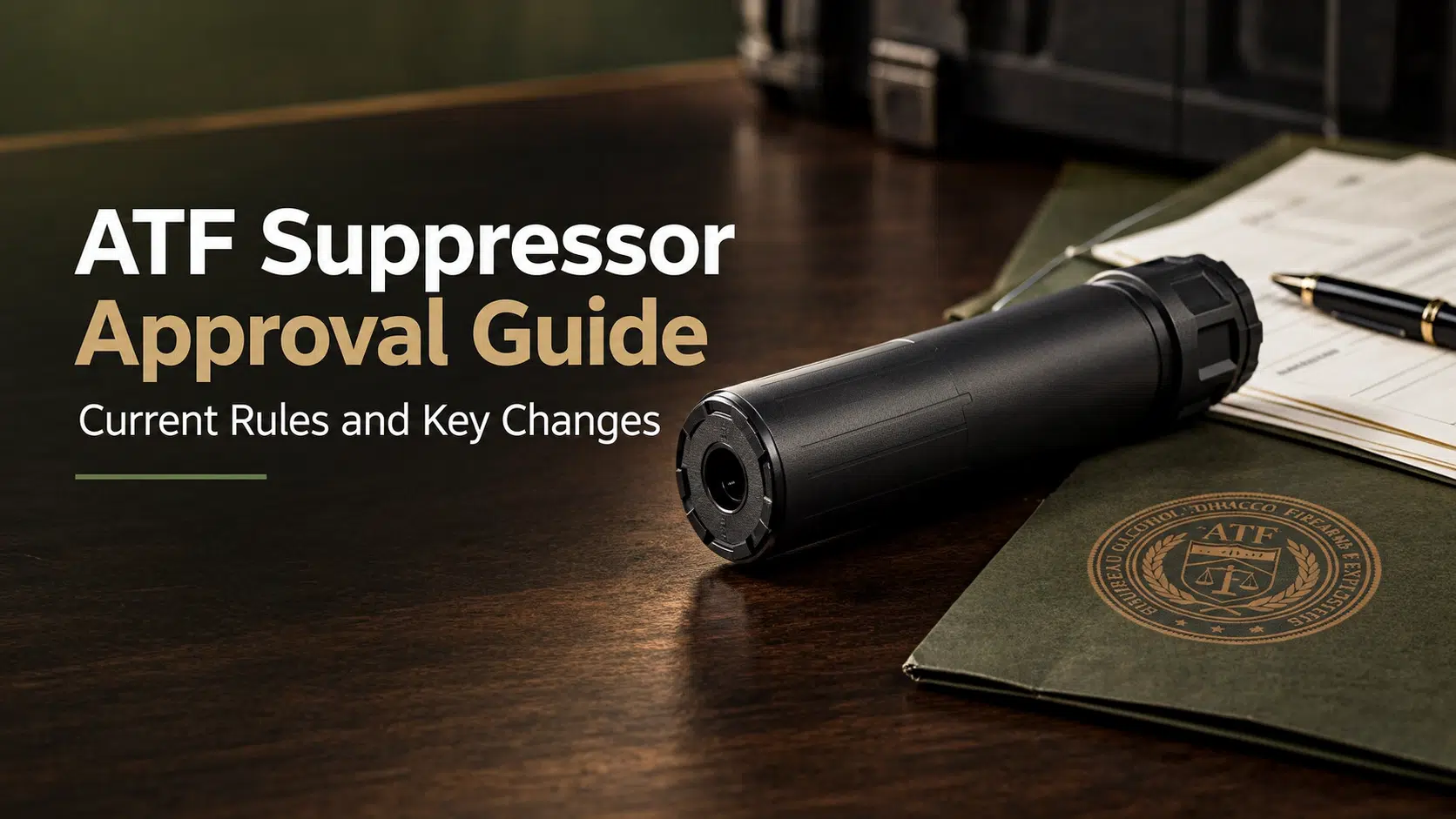
Suppressors, also called silencers, are firearm accessories designed to reduce the sound of a gunshot. In the United States, suppressor ownership has traditionally involved federal regulations, background checks, registration requirements, and an ATF approval process.
However, the rules changed significantly in October 2026. On October 9, 2026, the Bureau of Alcohol, Tobacco, Firearms and Explosives (ATF) issued updated guidance stating that it would no longer enforce certain federal approval, registration, and tax-stamp requirements for suppressors. State and local laws still apply, and other federal firearm requirements remain in effect. Source: ATF’s October 9, 2026, guidance.
This guide explains the current ATF suppressor rules, how background checks work, what the tax-stamp change means, how to understand reported wait times, and how to check the status of an application already submitted.
What Is the ATF Suppressor Approval Process?
Historically, the ATF suppressor approval process required individuals to apply, complete applicable background checks, pay the required federal tax, and wait for approval before taking possession of a suppressor.
The process commonly involved ATF Form 4 when purchasing a suppressor from a dealer. People making a suppressor themselves generally used ATF Form 1 under the former requirements.
The rules changed on October 9, 2026. Under its updated enforcement guidance, ATF stated that it would not enforce the federal National Firearms Act (NFA) requirements for individuals to obtain prior approval, register, or obtain a tax stamp for suppressors covered by the guidance.
This does not mean suppressors are unrestricted everywhere. State and local laws may still prohibit possession or impose additional requirements. Federal firearm laws, including applicable dealer-transfer and prohibited-person restrictions, also remain relevant.
Anyone considering a suppressor should review the current ATF guidance and applicable laws in their state before purchasing, making, possessing, or transferring one.
Current ATF Rules for Suppressor Ownership and Transfers
The ATF’s October 9, 2026, guidance followed a federal court decision and the Department of Justice’s decision not to appeal. The agency announced that it would exercise its enforcement discretion nationally for certain NFA provisions affecting suppressors and other covered items.
Under this guidance:
ATF will not enforce the covered federal requirement for individuals to obtain prior approval before making or transferring suppressors.
1) ATF will not enforce the covered NFA registration and tax-stamp requirements for suppressors.
2) State and local restrictions remain in effect.
3) Licensed dealers must continue following applicable Gun Control Act requirements, including Form 4473, background checks when required, and recordkeeping.
4) Federal restrictions on transfers to prohibited persons and other applicable firearm laws remain in effect.
The guidance also states that ATF will continue accepting voluntary NFA registrations and processing applications submitted by people who wish to register covered items.
Because this policy is based partly on enforcement discretion and legal developments, it could change if the relevant court decision or federal policy changes. Review the official ATF guidance for the latest information.
What Is an ATF Tax Stamp for a Suppressor?
An ATF tax stamp traditionally served as evidence of the federal tax payment and approval associated with an NFA firearm application. Suppressors were historically subject to a $200 federal making or transfer tax.
The tax provisions changed effective January 1, 2026, reducing the federal making and transfer tax on suppressors and certain other covered NFA items to $0. The October 9, 2026, ATF guidance subsequently stated that the agency would not enforce the covered tax-stamp and related requirements for suppressors.
This distinction matters: the tax reduction and the later non-enforcement guidance are separate developments. The October guidance changed how ATF would enforce the relevant approval and registration requirements; it did not eliminate every state or federal firearm law.
If you encounter older articles stating that every suppressor purchaser must pay $200 and receive an approved tax stamp, understand that this information may no longer reflect the current federal enforcement policy.
Is an ATF Application for a Suppressor Still Required?
Under the ATF’s October 9, 2026, guidance, individuals are no longer subject to enforcement of the covered federal requirement to apply for and receive prior ATF approval before making or transferring a suppressor.
However, ATF continues to accept voluntary applications and registrations. Some individuals may choose to submit an application for registration purposes, and state law may create additional considerations.
Historically, the application type depended on the transaction:
– ATF Form 4: Traditionally used for the transfer and registration of an NFA firearm, including a suppressor purchased from a dealer.
– ATF Form 1: Traditionally used to apply to make and register an NFA firearm.
– ATF Form 3: Traditionally used for certain tax-exempt transfers between qualified federal firearms licensees.
The current guidance states that ATF will not require these NFA forms for the covered suppressor transactions in the same way as under the former approval process, although voluntary submissions remain possible.
Before relying on a previous application guide, confirm whether it reflects the rules in effect on the date of your planned transaction.
ATF Background Check for Suppressors
The phrase “ATF background check for suppressor” commonly refers to the checks associated with the former NFA application process. Under the previous system, ATF reviewed submitted information and conducted applicable background checks before approving an application.
The October 9, 2026, guidance changed the enforcement of certain NFA approval and registration requirements. It did not eliminate all background checks associated with firearm transactions.
Licensed dealers must still follow applicable Gun Control Act requirements. For example, a dealer generally must complete ATF Form 4473 and conduct a National Instant Criminal Background Check System (NICS) check before transferring a firearm to an unlicensed buyer, unless an applicable legal exception applies. A suppressor transaction therefore should not be assumed to be free from all dealer procedures or legal restrictions simply because the former NFA approval requirements are no longer being enforced.
Buyers should confirm the applicable procedure with a properly licensed dealer and consult current ATF guidance.
Current ATF Suppressor Wait Times
Historically, suppressor wait times depended on the type of application, whether it was submitted electronically or on paper, the applicant’s circumstances, and ATF processing workloads.
The ATF continues to publish processing-time statistics for applications it receives and finalizes. Its official Current Processing Times page provides the latest figures published.
For context, the ATF page updated October 15, 2026, reported the following average processing times for applications finalized in August 2026:
– Individual Form 4 applications submitted electronically: approximately 6 days.
– Trust Form 4 applications submitted electronically: approximately 20 days.
– Individual Form 4 applications submitted on paper: approximately 28 days.
– Trust Form 4 applications submitted on paper: approximately 37 days.
These are historical processing averages for applications finalized during the specified month. They are not guaranteed wait times for new applications, and they do not mean that every suppressor purchaser must currently submit a Form 4. Since ATF’s October 9 guidance changed the enforcement of the former requirements, readers should interpret these figures in the context of voluntary registrations and applications already in the system.
Always check the official processing-times page for updated figures rather than relying on an older estimate.
How to Check ATF Suppressor Status Online
If you previously submitted an ATF suppressor application or voluntarily registered a suppressor, you may want to check its status.
The appropriate method depends on how the application was submitted and whether it remains under review.
- Check your submission records. Locate your application confirmation, reference number, or other information provided when you submitted the paperwork.
- Review your ATF eForms account. If you submitted through eForms, sign in through the official ATF eForms portal and check the information available for your submission.
- Contact your dealer if applicable. If a dealer submitted the paperwork, ask whether they have received an update or can help identify the application status.
- Contact the ATF when necessary. Use the official ATF contact information if the status is unavailable online or you need clarification about an existing application.
Remember that the updated policy does not automatically establish the status of every application submitted before October 9, 2026. An application may still appear in the system, and voluntary registrations may continue to be processed.
Use official ATF channels for status information rather than relying on unofficial estimates or third-party claims.
FAQ’s
Q1. What does the ATF consider a suppressor?
The ATF defines a firearm silencer or suppressor as a device intended to silence, muffle, or reduce the sound of a firearm. The definition can also include certain parts designed specifically to assemble or manufacture a suppressor. See the ATF’s official firearms guidance.
Q2. How do I know if the ATF approved my suppressor?
If you applied, check your ATF eForms account or contact the dealer who submitted it. Under the ATF’s October 9, 2026, guidance, prior federal approval is no longer being enforced for covered suppressor transactions, although state laws and other firearm requirements still apply.
Q3. How long is the ATF taking to approve suppressors right now?
Processing times vary. The ATF’s official processing-times page reports averages for applications already finalized; these are not guaranteed wait times for new applications. Check the page for the latest figures.
Q4. How hard is it to get approved for a suppressor?
Under the ATF’s guidance issued October 9, 2026, the agency is no longer enforcing certain federal prior-approval requirements for suppressors. However, buyers must still comply with applicable dealer background checks, state laws, and restrictions on firearm possession.
Q5. What ATF form do I need to complete for a suppressor?
Historically, ATF Form 4 was used to transfer a suppressor from a dealer, while ATF Form 1 was used to apply to make one. Under October 9, 2026, guidance, ATF continues accepting voluntary applications, but the former federal prior-approval requirement is no longer being enforced for covered suppressor transactions. See the official ATF firearms forms.