
A suppressor can change the way a hunting rifle behaves in the field by reducing the firearm’s report and, depending on the setup, making the shooting experience more manageable. For hunters consider hunting with a suppressor, however, there is more to consider than simply attaching one to a rifle.
The legality of suppressor use for hunting depends on the state and, in some cases, the specific hunting regulations that apply to the species or season. Suppressors are regulated under federal law, while their possession and hunting use are also subject to state law. Hunters should verify the current regulations for the state and hunting area before taking a suppressed rifle into the field. Beyond legality, hunters should consider rifle configuration, ammunition, bullet performance, weight, balance, and how the suppressor affects the rifle’s overall handling.
What Is a Suppressor?
A suppressor, sometimes called a silencer, is a device attached to a firearm to reduce the sound produced when the firearm is discharged. It does not make a rifle completely silent. The device works by providing a controlled space for expanding propellant gases to cool and slow before they leave the muzzle. The actual reduction in sound depends on the firearm, cartridge, ammunition, suppressor, and shooting environment.
For hunters, the important point is that a suppressor is part of the overall rifle system. Adding one can affect the rifle’s length, weight, balance, and point of impact, which is why the complete setup should be tested before hunting.
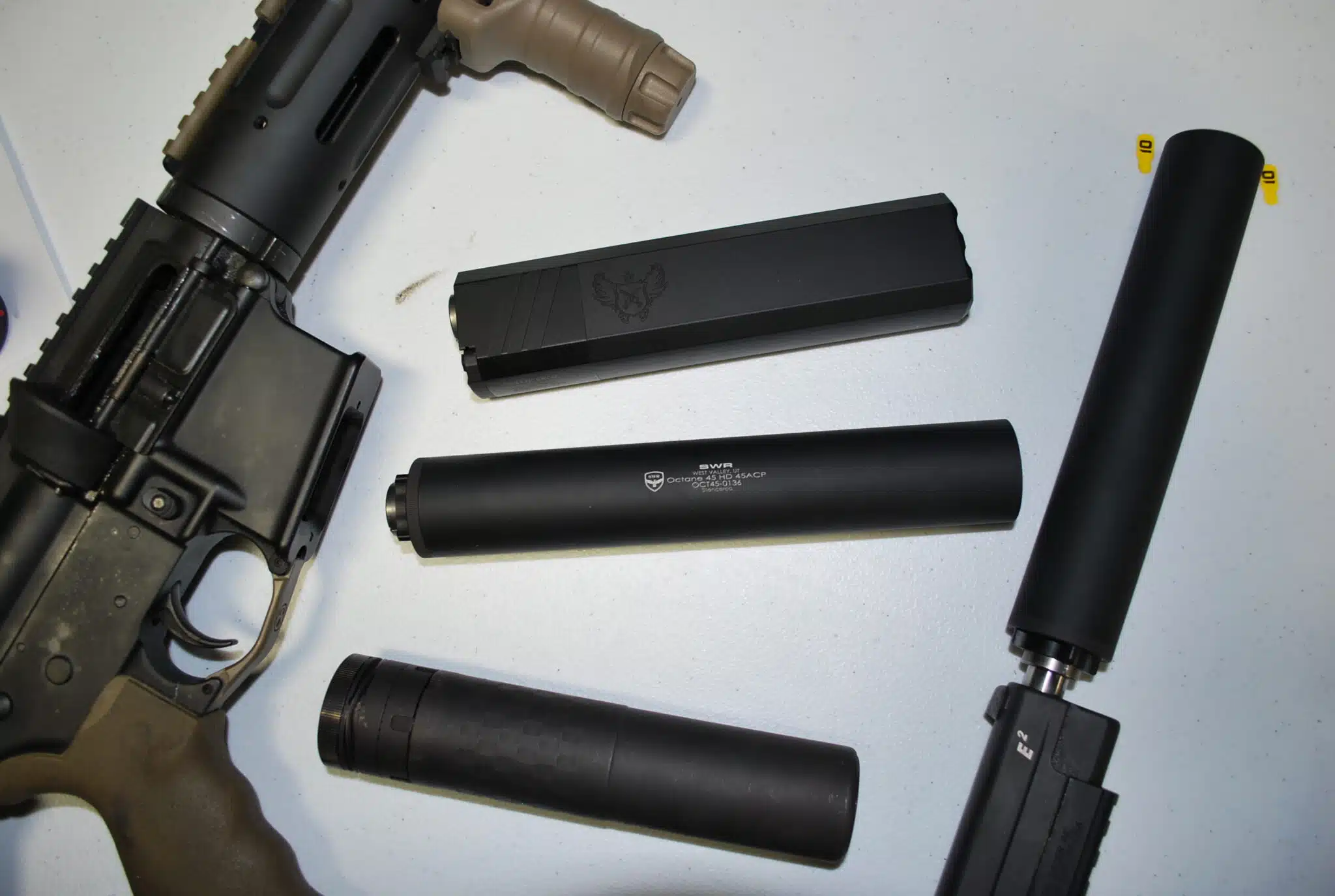
Firearm suppressors including the SilencerCo Osprey 9, SWR Octane 45, and SilencerCo Saker 5.56
Source-Wikipedia
Can You Hunt with a Suppressor?
Yes, hunting with a suppressor is permitted in many parts of the United States, but it is not legal everywhere. Regulations can differ by state, species, season, and hunting area.
ATF notes that suppressor legality is determined on a state-by-state basis. Its current state-law resources should be checked alongside the applicable state wildlife agency’s hunting regulations.
Hunters should confirm:
– Whether suppressor possession is legal in their state
– Whether suppressor use is permitted while hunting
– Whether the specific species or season has additional restrictions
– Whether public-land or local regulations impose additional requirements
– Whether the firearm and ammunition meet the applicable hunting regulations
Because regulations can change, hunters should check the current rules before every season rather than relying on an old state-by-state list.
Benefits of Hunting with a Suppressor
Reduced Report
One of the primary reasons hunters use suppressors is to reduce the firearm’s report. A suppressor does not eliminate the sound of a gunshot, but it can make the report less severe.
More Comfortable Shooting
Reducing the intensity of the report can make shooting more comfortable, particularly during extended practice sessions. This can be useful when sighting in a hunting rifle or practicing before a season.
Less Disturbance in the Field
A suppressed rifle may produce less disruptive sound than the same rifle without a suppressor. This can be relevant when hunting in areas where multiple shots may otherwise disturb nearby wildlife.
Reduced Muzzle Blast
A suppressor can also reduce the amount of muzzle blast experienced by the shooter. This can be particularly noticeable with cartridges that produce substantial muzzle pressure. It is important, however, not to treat a suppressor as hearing protection. Hunters should continue to use appropriate hearing protection whenever practical.
How Does a Suppressor Affect Hunting Rifle?
Adding a suppressor changes the physical characteristics of the rifle.
The additional weight at the muzzle can affect the rifle’s balance and how quickly it can be brought into position. The overall length also increases, which can be noticeable when moving through thick timber or transporting the rifle. A suppressor can also change the rifle’s point of impact. Even when the same ammunition is used, adding or removing the suppressor can result in a different point of impact.
For this reason, a rifle should be zeroed in the exact configuration in which it will be hunted.
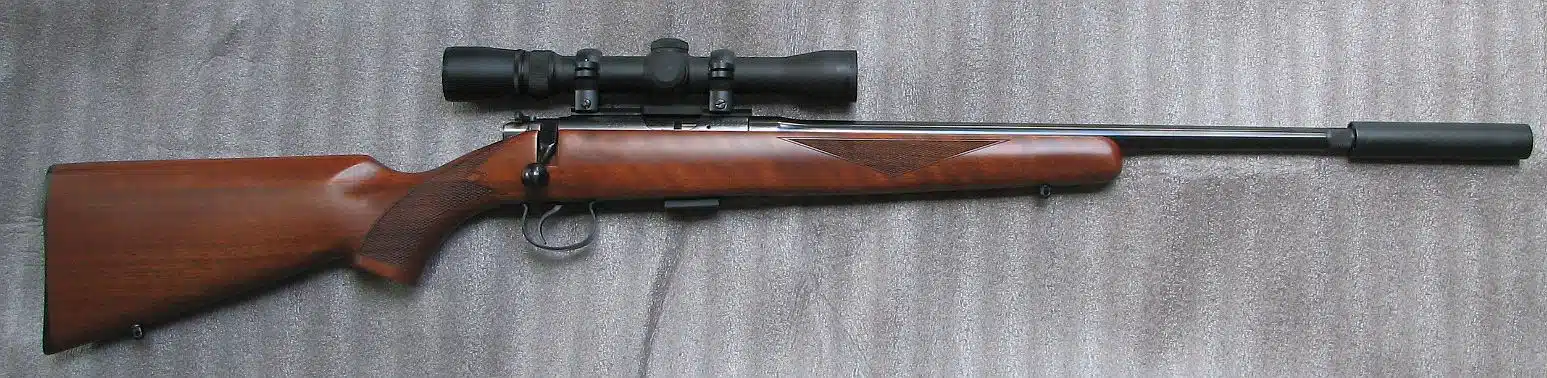
Hunting rifle with suppressor
Source-Wikipedia
Choosing a Rifle Suppressor for Hunting
There is no single best hunting suppressor for every hunter. The appropriate choice depends on the rifle, cartridge, hunting environment, and the amount of weight and length the hunter is willing to add.
Important considerations include:
Caliber Compatibility
The suppressor must be appropriate for the cartridge and projectile diameter being used. Hunters should follow the suppressor manufacturer’s specifications rather than assuming that a particular model is suitable for every rifle cartridge.
Weight
A lightweight suppressor can be attractive for hunters who carry their rifles long distances. A heavier model may offer different performance characteristics but can noticeably change the balance of a lightweight hunting rifle.
Length
Additional barrel length can become inconvenient in dense timber or when hunting from confined positions. Suppressor dimensions should therefore be considered alongside the rifle’s existing barrel length.
Mounting System
The mounting system should be appropriate for the rifle and suppressor combination. Hunters should ensure that the suppressor is properly installed and aligned before firing.
Rifle and Ammunition Combination
The suppressor, rifle, and ammunition should be treated as one system. Hunters should test the exact combination before hunting and confirm accuracy, point of impact, feeding, and function.
Ammunition Considerations for Suppressed Hunting
A suppressor does not turn unsuitable ammunition into suitable hunting ammunition. Bullet construction and terminal performance remain important regardless of whether a suppressor is used.
Hunters should select ammunition according to the game being pursued and the bullet’s intended performance.
For example, Steinel offers hunting ammunition across several rifle cartridges that can be relevant to suppressed hunting setups, depending on the firearm and suppressor specifications.
338 Federal
For hunters using a .338 Federal rifle, Steinel currently offers:
– 165gr Solid Copper Hollow Point
– 200gr Controlled Expansion Soft Point
The 165-grain load provides a lighter hunting projectile with high weight retention, while the 200-grain controlled-expansion bullet is intended for applications where heavier bullet weight and penetration are important.
30-06 Springfield
The .30-06 Springfield is another common hunting cartridge that can be paired with a suppressed hunting rifle when the firearm, suppressor, and ammunition are properly matched.
Steinel offers several .30-06 loads, including options intended for hunting and M1 Garand applications. Hunters should select ammunition according to the firearm and intended use rather than assuming every .30-06 load is appropriate for every rifle.
7.62×54mmR
For hunters using rifles chambered in 7.62×54mmR, ammunition selection should likewise be based on the rifle’s chambering and intended application. Steinel offers a 174-grain FMJBT load for this cartridge, which is more suited to range and rifle practice than a dedicated hunting projectile.
This is an important distinction: the presence of a suppressor does not determine whether ammunition is appropriate for hunting. The bullet and its intended application still matter.
Hunting With a Suppressor: What About Accuracy?
A suppressor does not automatically make a rifle more accurate.
What it can do is change the rifle’s point of impact and potentially alter the way the rifle behaves when fired. The amount of change varies between rifles and suppressor systems.
Hunters should therefore:
- Install the suppressor correctly.
- Confirm the rifle’s zero with the suppressor attached.
- Shoot the actual hunting ammunition being used.
- Check accuracy at the distances relevant to the hunt.
- Confirm the point of impact again if the suppressor is removed or replaced.
The goal is not simply to sight in the rifle with a suppressor; it is to establish the rifle’s actual performance in the configuration that will be used in the field.
Hunting Suppressors for Different Hunting Situations
Dense Timber
A compact suppressor and rifle combination may be more practical in dense timber, where excessive length and weight can make a rifle cumbersome.
Mountain Hunting
Weight becomes particularly important when a rifle is carried over long distances or significant elevation. Hunters may therefore place greater emphasis on a lightweight overall setup.
Open-Country Hunting
In open country, rifle balance and weight may be less restrictive than in dense cover, although the suppressor still needs to be matched correctly to the rifle and cartridge.
Range Practice Before Hunting Season
A suppressed rifle should be practiced with before the hunt. This gives the shooter an opportunity to become familiar with the rifle’s altered balance, recoil characteristics, sound, and point of impact.
Are Hunting Silencers Safe?
A properly installed and correctly rated suppressor can be used as part of a hunting rifle setup, but it should not replace normal firearm safety practices. Hunters should use equipment according to the manufacturer’s specifications, verify compatibility with the firearm and ammunition, and inspect the system before use.
Hearing protection is also still advisable. A suppressor reduces sound; it does not eliminate the need to protect hearing.
What to Consider Before Using a Suppressor for Hunting
Before heading into the field, hunters should review four areas:
Legal requirements: Confirm that suppressor possession and hunting use are permitted where the hunt will take place.
Equipment compatibility: Confirm that the suppressor is appropriate for the rifle and cartridge.
Ammunition: Use hunting ammunition appropriate for games and firearms.
Zero and accuracy: Confirm the rifle’s point of impact with the suppressor attached and the exact ammunition intended for the hunt.
Frequently Asked Questions
Q1. Are suppressors worth it for hunting?
Yes, for many hunters they can reduce muzzle blast and make shooting more comfortable. The added weight, length, and legal requirements should also be considered.
Q2. Can you legally hunt with a suppressor?
In many U.S. states, yes, but hunting regulations vary by state and species. Always check the current regulations where you plan to hunt.
Q3. Can I just walk in and buy a suppressor now?
No. Suppressors are federally regulated NFA firearms and require the applicable ATF transfer and registration process before possession.
Q4. Is there a downside to suppressors?
Yes. They add weight and length to the rifle and can change its balance and point of impact, so the rifle should be re-zeroed with the suppressor attached.
Q5. What is the best caliber for suppressed deer hunting?
There is no single best caliber; .308 Winchester, .30-06 Springfield, and .338 Federal are all capable deer-hunting cartridges when properly matched with hunting ammunition.
Q6. Can my son hunt with my suppressor?
It depends on how the suppressor is registered and applicable to federal and state laws; it should not simply be treated as ordinary shared hunting equipment.







#/media/File:Silencerco_Osprey_9,_SWR_Octane_45,_and_Silencerco_Saker_5.56.JPG)
#/media/File:CZ_452_A_silencer_large.jpg)