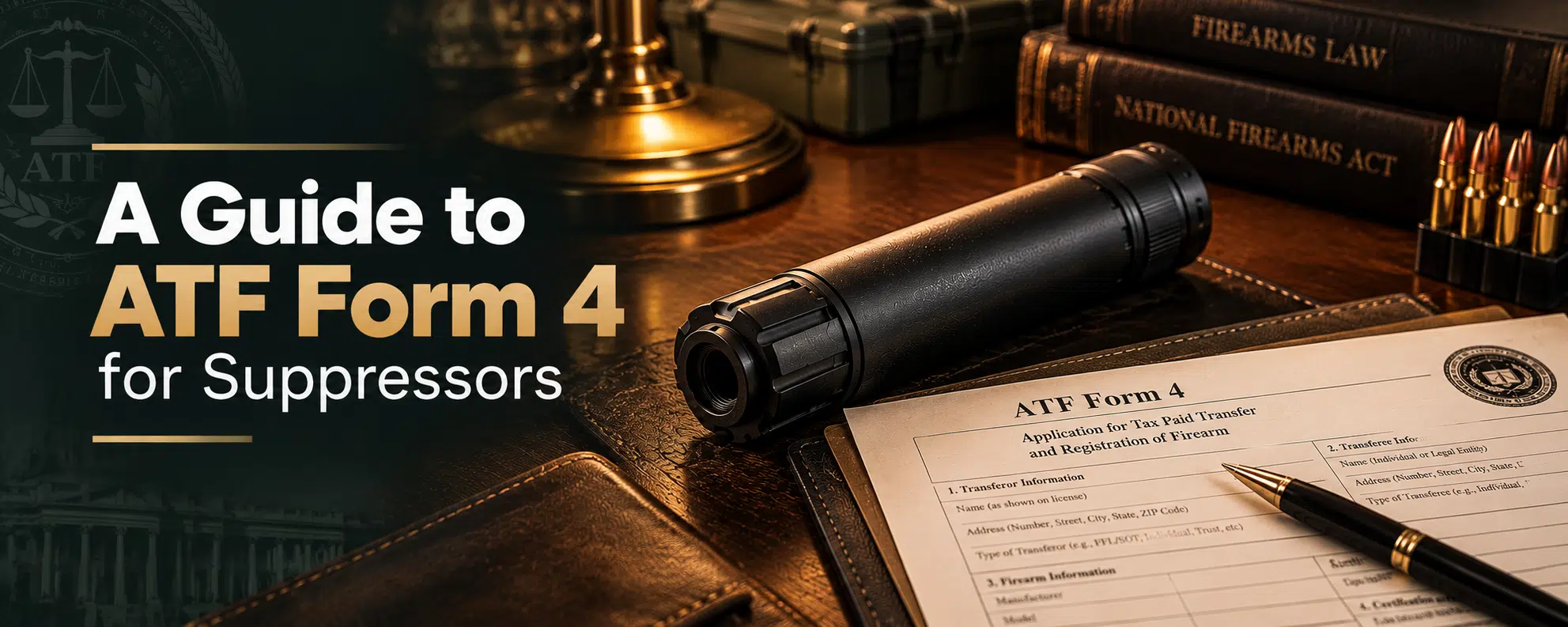
ATF Form 4 is an official federal form historically used when transferring a suppressor or another National Firearms Act (NFA) firearm to an individual or eligible legal entity. It records information about the item, the transferor, and the recipient.
If you have searched for ATF Form 4 for suppressor, you may have found instructions describing a process involving paperwork, background checks, a tax stamp, and approval before taking possession. Those instructions explain the traditional process, but an important policy change occurred in October 2026. Download ATF Form Here
On October 9, 2026, the Bureau of Alcohol, Tobacco, Firearms and Explosives (ATF) announced that it would no longer enforce certain federal NFA approval, registration, and tax-stamp requirements for covered suppressor transactions. The agency continues to accept voluntary applications, and state and local restrictions still apply. This guide explains what Form 4 means, how it differs from other ATF forms, what information it historically required, and where to find the latest official guidance.
What Is ATF Form 4 Used For?
ATF Form 4 is officially titled Application for Tax Paid Transfer and Registration of Firearm. Historically, it was used to request the transfer and registration of an NFA-regulated item, including a suppressor, from a qualified transferor to an individual or eligible entity.
The form was designed to document the transaction and identify the item being transferred. Depending on the applicant and transaction, the traditional process also involved supporting information and eligibility checks. The form remains available through the ATF, but its traditional role should be understood considering the agency’s October 2026 guidance.
For the official form and its instructions, visit the ATF Firearms Forms page.
What Information Does ATF Form 4 Contain?
The traditional Form 4 collects information needed to identify the transfer and the parties involved. Its sections have included details such as:
– Transferor information: Details identifying the dealer or other eligible party transferring the item.
– Transferee information: Details about the person or legal entity receiving it.
– Item identification: Information such as the suppressor’s manufacturer, model, caliber, and serial number, where applicable.
– Applicant declarations: Required responses, certifications, and signatures.
– Supporting documentation: Additional materials required under the applicable form instructions and circumstances.
The information must accurately describe the transaction and the item. If you are reviewing a previous submission or considering a voluntary application, use the instructions for the relevant form version rather than relying on an older online checklist.
How to Fill Out ATF Form 4 for a Suppressor
People searching for how to fill out ATF Form 4 for a suppressor should first determine whether they need to submit a form under the rules that currently apply to their situation.
Historically, completing Form 4 involved identifying the parties, entering the suppressor’s information, supplying the required supporting documents, reviewing the declarations, and submitting the application through the appropriate process.
Before using older instructions, consider these points:
Confirm the purpose of the submission. Form 4 was traditionally associated with transferring and registering an NFA firearm. The current federal enforcement policy for covered suppressor transactions is different from the former process.
Use the correct official form. ATF publishes its forms and instructions online. Make sure you are using the appropriate version for your circumstances.
Check the information carefully. Incorrect identifying details or incomplete information can cause problems with an application or record.
Verify current requirements before submitting. ATF’s October 9, 2026, guidance changed the enforcement of certain federal requirements. Voluntary submissions may still be made, and state laws may impose separate obligations.
For electronic forms and official submission guidance, visit the ATF eForms page.
ATF Form 4 vs. Form 1 vs. Form 3
The main difference between these forms is their traditional purpose.
| ATF form | Traditional purpose |
| Form 1 | Application to make and register an NFA firearm |
| Form 3 | Certain tax-exempt transfers between qualified federal firearms licensees |
| Form 4 | Transfer and registration of an NFA firearm to an individual or other eligible recipient |
For example, Form 1 historically applied to a person seeking authorization to make an NFA firearm, while Form 4 was commonly associated with a suppressor transfer from a dealer.
These descriptions explain the forms’ traditional functions. The October 2026 guidance changed the enforcement of certain NFA requirements for suppressors, so the former process should not automatically be treated as mandatory for every transaction.
Does ATF Form 4 Still Apply to Suppressors in 2026?
The answer depends on what you mean by “apply.”
On October 9, 2026, ATF announced that it would not enforce certain federal requirements for individuals to obtain prior approval before making or transferring covered suppressors. The agency also stated that it would not enforce the associated NFA registration and tax-stamp requirements for those covered items.
This was an enforcement-policy announcement, not a repeal of every law that may affect suppressors. State and local restrictions remain in place, and licensed dealers must continue complying with applicable federal firearm-transfer requirements.
ATF also stated that it would continue processing applications submitted by people who wish to register covered items voluntarily. Consequently, Form 4 remains relevant to understanding existing records, voluntary submissions, and the traditional transfer process.
Read the full ATF Update to NFA Transfer Guidance before relying on older instructions.
How to Find the Official ATF Form 4 and Instructions
The safest starting point is the ATF’s own website rather than an outdated third-party guide.
- Open the ATF Firearms Forms page.
- Find Form 4, listed as Application for Tax Paid Transfer and Registration of Firearm.
- Review the available form and its instructions.
- If electronic filing is relevant to your situation, visit the ATF eForms page.
- Read the October 9, 2026, NFA guidance to understand the current enforcement policy.
For questions about a particular submission, ATF’s eForms information page provides official support and contact details. A dealer who handled an earlier transaction may also be able to clarify the records associated with it.
Understanding Form 4 Processing Information
Historically, people submitting Form 4 often monitored processing times to estimate when an application might be finalized. ATF still publishes statistics for applications it has processed.
Its Current Processing Times page reports averages for finalized applications. These figures describe past processing activity and are not guarantees for an individual application.
Because ATF’s October 2026 guidance changed the enforcement of certain suppressor requirements, historical Form 4 processing times should not be interpreted as a universal waiting period for all suppressor transactions.
If you have already submitted a form, check your own records and the official ATF channels for information about that submission.
Frequently Asked Questions
Q1. What is ATF Form 4 for a suppressor?
ATF Form 4 has traditionally been used to transfer and register a suppressor under the National Firearms Act. ATF continues to accept voluntary applications following its October 2026 guidance.
Q2. How do I fill out ATF Form 4 for a suppressor?
Historically, applicants provided information about the transferor, recipient, suppressor, and required supporting documents. Check the current ATF instructions before submitting a form because federal guidance changed in October 2026.
Q3. What ATF form do you need for a suppressor?
Form 4 was traditionally used for transfers, while Form 1 was used to apply to make an NFA firearm. Whether a form is currently needed depends on the applicable requirements and circumstances.
Q4. Is ATF Form 4 still required for suppressors?
ATF’s October 9, 2026, guidance states that it will not enforce certain federal prior-approval and registration requirements for covered suppressor transactions. State and local laws may still impose restrictions.
Q5. Can I submit ATF Form 4 electronically?
ATF offers electronic filing for Form 4 through its eForms system. Check the current guidance to determine whether a submission is appropriate for your circumstances.
Q6. Where can I check the status of a submitted Form 4?
Start with the ATF eForms portal if you submitted electronically. You can also consult the dealer involved or use the official ATF contact information for questions about an existing submission.
Final Thoughts
ATF Form 4 has traditionally documented the transfer and registration of suppressors and other NFA firearms. It remains useful to understand the form when reviewing older transactions, researching voluntary submissions, or reading historical guidance.
However, the federal enforcement policy changed on October 9, 2026. Before following a traditional Form 4 checklist, review the latest ATF guidance and the laws that apply in your state and locality.
Use official ATF forms and resources for the most current information rather than if older instructions still describe a mandatory process.