
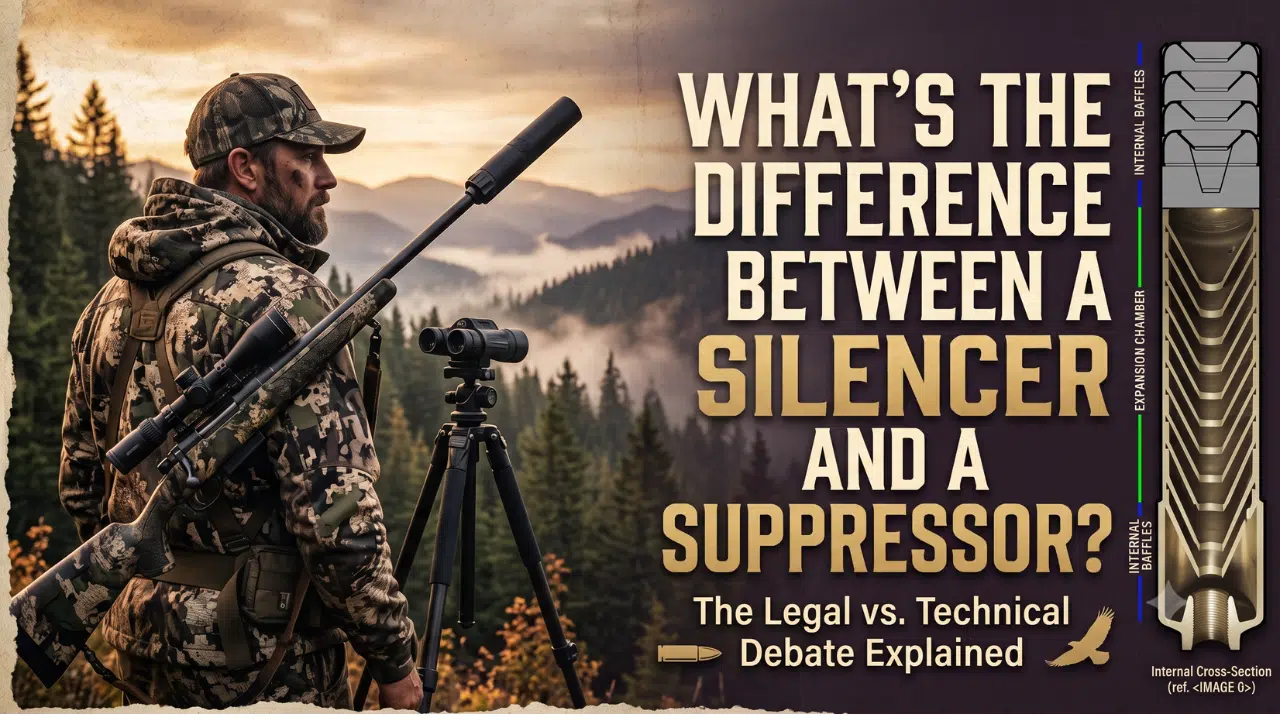
Silencer vs. Suppressor: Are They Actually Different?
If you have searched for information about firearm sound reduction, you have probably encountered two terms: silencer and suppressor.
This often raises a simple question: what’s the difference between a silencer and a suppressor?
In practical terms, there is no separate device called a silencer, and another called a suppressor. The two terms generally describe the same type of firearm sound-reduction device. The difference is primarily terminology.
The word silencer is the older term and is also the terminology used in U.S. federal law. Suppressor became common because the device reduces the sound of a firearm rather than making the firearm completely silent.
The National Firearms Act and federal regulations use the terms silencer and firearm muffler in their legal definitions. SAAMI, meanwhile, defines a suppressor as a device attached to the muzzle of a firearm to reduce the noise of discharge and notes that it is sometimes called a silencer.
Why Are There Two Names for the Same Device?
The terminology has changed over time.
Early firearm sound-reduction devices were commonly marketed as silencers. Hiram Percy Maxim developed an early firearm silencing device, and his U.S. patent for a “Silent Firearm” was granted in 1909. The patent describes controlling and redirecting firearm gases after the projectile passes through the barrel.
As firearm terminology developed, suppressor became increasingly common. The term better reflects what the device actually does: it suppresses the report and muzzle blast rather than eliminating sound completely. That distinction matters because a suppressed firearm is still audible.
What Does a Suppressor Actually Do?
A firearm produces sound from several sources, including the rapid release of high-pressure propellant gases at the muzzle. A suppressor provides an enclosed structure around the muzzle through which those gases can expand and cool before exiting into the atmosphere.
Most conventional suppressors contain some combination of:
– An outer tube or body
– An expansion area
– Internal baffles or other gas-management structures
– A rear mounting interface
– A front end cap
The internal geometry gives the expanding gases additional space and surfaces to interact with before they leave the device. ATF’s National Firearms Act Handbook describes firearm silencers as generally consisting of an outer tube, internal baffles, a front end cap, and a rear end cap.
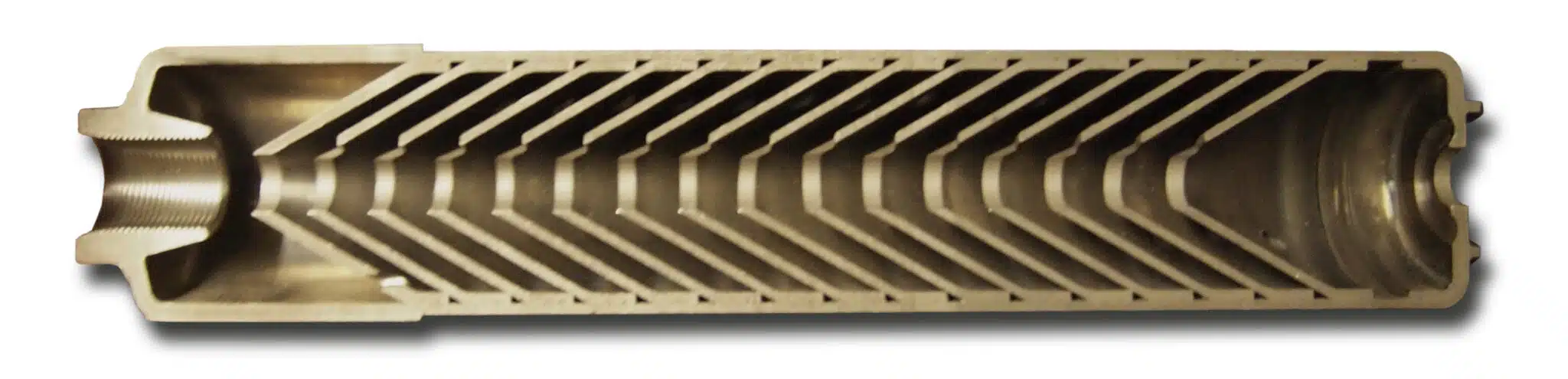
Cutaway of a suppressor
Source-Wikipedia
The different cross-sectional designs demonstrate that there is no single internal configuration that defines a suppressor.
Is a Suppressor Completely Silent?
No, this is one of the biggest misconceptions associated with the word silencer.
A suppressor is designed to reduce the sound produced by firing, not eliminate it entirely. The resulting sound depends on several variables, including:
– Firearm and barrel configuration
– Ammunition
– Projectile velocity
– Cartridge
– Suppressor design
– Environmental conditions
– Whether the projectile remains below or exceeds the speed of sound
A suppressor also does not eliminate every sound associated with firing. Mechanical noise from the firearm and the projectile’s flight can remain audible.
This is why “suppressed” does not mean “silent.”
Silencer vs. Suppressor: Is One More Correct?
For ordinary discussion, both terms are correct.
If someone says “silencer,” they are generally referring to the same device another person might call a “suppressor.”
The terminology can differ depending on context-
| Term | Meaning |
| Silencer | Common historical and legal term for a firearm sound-reduction device |
| Suppressor | Common modern term describing the device’s function |
| Firearm muffler | Another term appearing in federal legal definitions |
| Sound suppressor | Descriptive term commonly used for the same device |
Under federal law, the terminology is particularly important because U.S. statutes and regulations use silencer/firearm muffler terminology. ATF identifies a silencer as a device for silencing, muffling, or diminishing the report of a portable firearm.
So if you’re asking about the suppressor vs silencer difference, there isn’t a functional difference between two separate products simply because one is called a silencer and the other a suppressor.
What Does a Suppressor Look Like Internally?
The internal construction varies considerably between designs.
Some suppressors use a series of individual baffles. Others incorporate different gas-flow structures, expansion chambers, or combinations of internal elements.
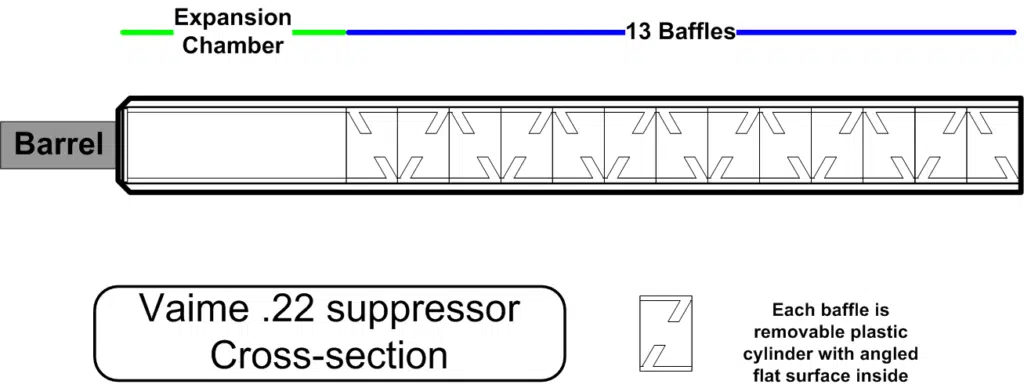
Suppressor cross-section with an expansion chamber and baffles
Image source: Wikipedia
This cross-section shows another approach to gas management, with an expansion area followed by multiple baffles. The geometry illustrates how the internal design provides space and surfaces for propellant gases to expand and change direction.
What Is a Reflex or Integral Suppressor Design?
Not every suppressor simply extends forward from the muzzle.
Some designs incorporate an expansion chamber that extends rearward around part of the barrel. This is commonly referred to as a reflex-style configuration.
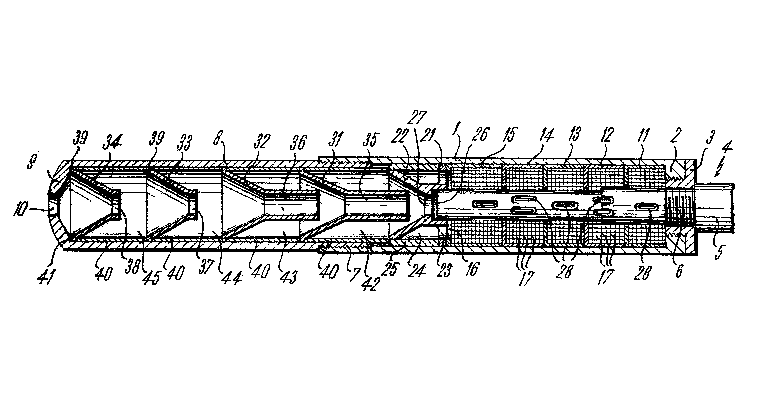
Cross-section of a suppressor integral to the firearm
Image Source – Wikipedia
This type of design demonstrates how suppressor architecture can be integrated more closely with the firearm and barrel rather than consisting solely of a conventional forward-mounted tube. The design can affect overall length, balance, internal volume, and how the device interacts with the firearm.
Does Ammunition Matter When Using a Suppressor?
Yes, the ammunition is an important part of the overall shooting system.
One major consideration is projectile Velocity.
When a projectile travels faster than the speed of sound, it creates a ballistic crack as it travels through the air. A suppressor does not eliminate that sound because it occurs along the projectile’s flight path rather than solely at the muzzle.
Subsonic ammunition, when appropriate for the firearm and application, can avoid the ballistic crack associated with supersonic flight.
However, subsonic ammunition should only be used when the specific cartridge, firearm, barrel, and load are compatible. Ammunition selection should always follow the firearm manufacturer’s specifications and published ammunition data.
Frequently Asked Questions –
Q1. Can you own a suppressor without a license?
You don’t need an FFL simply to own one, but suppressors are regulated under the NFA and require ATF approval before lawful possession.
Q2. What are the downsides of a suppressor?
Suppressors can add weight and length to a firearm, change its balance, and may affect point of impact.
Q3. Why are suppressors so illegal?
Suppressors are not illegal nationwide. They are federally regulated under the NFA, while state laws determine whether they can be possessed and used.
Q4. Can I put my suppressor on any gun I own?
No. The suppressor must be compatible with the firearm, caliber, ammunition, and mounting system.
Q5. Can ATF come to your house if you have a suppressor?
Owning a registered suppressor does not give ATF unrestricted authority to enter your home. You should retain your approved NFA registration documents.
Q6. What states allow silencers?
Suppressors are legal in many U.S. states, but state laws vary. Always check the current laws where you live.
Q7. Can I let my friend shoot my suppressor?
Generally, allowing someone to shoot your firearm with your suppressor attached is different from transferring the suppressor. However, applicable federal and state laws should be followed.






#/media/File:Cross_section_of_a_suppressor_01_noBG.jpg)
#/media/File:Vaime-Suppressor-22-WP-Drwg.png)
#/media/File:Patent_DE1553874_07-Oct-1971_Handfeuerwaffe_mit_Schalldaempfer_Heckler_und_Koch.png)