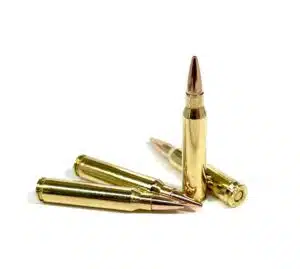
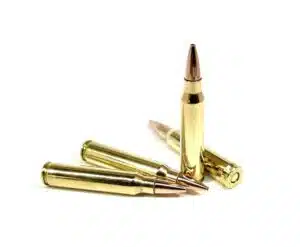
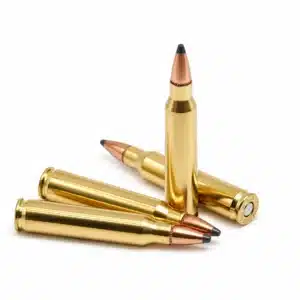
That speed translates into exceptional accuracy at distance, reduced wind drift compared to heavier subsonic projectiles, and low recoil that makes fast follow-up shots manageable even for newer shooters. It is also one of the most widely produced and affordable centerfire rifle cartridges in the world, which makes it the default choice for high-volume range training.
.300 Blackout vs 5.56: Key Differences
| Attribute |
.300 Blackout (Supersonic) |
5.56 NATO |
| Bullet Weight |
110–125 gr (supersonic) / 190–220 gr (subsonic) |
55–77 gr |
| Muzzle Velocity |
~2,200–2,350 fps (supersonic) |
~2,900–3,100 fps |
| Effective Range |
300–400 yards (supersonic) |
500+ yards |
| Energy at Muzzle |
~1,200–1,400 ft-lbs. |
~1,100–1,350 ft-lbs |
| Recoil |
Moderate |
Low |
| Suppressor Suitability |
Excellent (especially subsonic) |
Fair |
| Ammunition Cost |
Higher |
Lower |
| Short Barrel Performance |
Excellent |
Diminished |
If you’re working inside 300 yards and value heavier projectiles, suppressor compatibility, or short-barrel efficiency, the .300 BLK has a clear edge. If you need range, accuracy at distance, and affordable training ammo, 5.56 wins.
.300 Blackout vs 5.56 Size Comparison
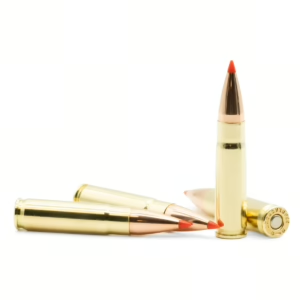
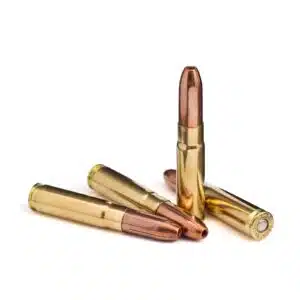
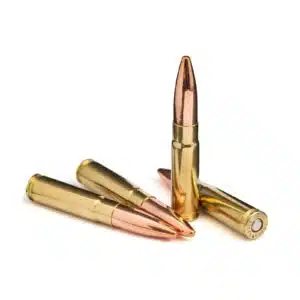
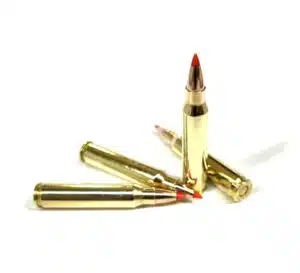
A side-by-side comparison highlights the differences clearly.
The 5.56 NATO fires a small-diameter, lightweight bullet at very high velocity. The projectile itself measures .224 inches in diameter, the same as .223 Remington. Case length is approximately 44.7 mm, and the overall cartridge length is about 57.4 mm.
The .300 Blackout fires a .308-inch diameter bullet from a shorter, modified case. Case length is approximately 34.7 mm significantly shorter than 5.56 – but the wider, heavier bullet seated on top gives the cartridge a completely different energy profile. Overall cartridge length is similar to 5.56 by design, which is exactly why it feeds from the same magazines and runs in the same lower receiver.
The 300 Blackout vs 5.56 size difference is most consequential in two ways:
- The .30-caliber projectile creates a larger wound channel, a meaningful advantage for hunting and defensive applications.
- The shorter case allows .300 BLK to run reliably in short-barreled configurations where 5.56 can suffer from incomplete powder burn and reliability issues.
300 Blackout vs 5.56 Ballistics Comparison
Velocity Comparison
Velocity is where 5.56 holds a decisive advantage, at least in supersonic configurations.
From a 16-inch barrel, 5.56 NATO typically exits the muzzle at 2,900 to 3,100 fps depending on load. That velocity enables a flatter trajectory and makes it significantly easier to hold accurate hits at 300 to 500 yards without extensive holdover corrections.
Supersonic .300 BLK, by contrast, achieves muzzle velocities of approximately 2,200 to 2,350 fps. Subsonic .300 BLK operates below 1,100 fps by definition, which is the point of the subsonic configuration. Those lower velocities produce a more pronounced trajectory arc that requires meaningful holdover corrections at any distance beyond 200 yards.
Understanding the 300 Blackout vs 5.56 ballistics difference is critical, as velocity influences everything downstream: trajectory, retained energy, wind drift, and terminal performance.
Energy and Impact
Despite its lower velocity, supersonic .300 BLK delivers comparable or slightly superior muzzle energy to 5.56, because it’s launching a heavier projectile.
A 125-grain .300 BLK load at 2,250 fps produces roughly 1,400 ft-lbs. of muzzle energy. A 55-grain 5.56 load at 3,100 fps produces approximately 1,175 ft-lbs. The heavier .300 BLK bullet also retains energy more efficiently at close range because it doesn’t depend on high velocity to initiate expansion in the same way lighter, faster projectiles do.
At longer ranges, this reverses. The 5.56 vs 300 Blackout ballistics gap widens in 5.56’s favor past 200 to 300 yards, where the lighter, high-velocity bullet maintains a flatter trajectory and the .300 BLK’s energy drops more steeply.
Trajectory Differences
The ballistics of 300 Blackout vs 5.56 diverge most noticeably in trajectory.
Zero a 5.56 at 100 yards, and holdover corrections to 300 and 400 yards remain modest and manageable. Zero supersonic .300 BLK at the same distance, and you’ll need to account for noticeably more drop at ranges beyond 200 yards. For suppressed and subsonic configurations, the trajectory difference becomes even more significant. Subsonic .300 BLK drops sharply past 150 yards and is best treated as a 100-to-150-yard cartridge for accurate precision work.
300 Blackout vs 5.56 for Home Defense
300 Blackout vs 5.56 for home defense is one of the more nuanced caliber discussions you’ll have, and the answer depends heavily on your specific setup and priorities.
Close-Range Effectiveness
Inside a home, distances are short often 5 to 25 yards. At that range, both cartridges are capable of producing effective terminal performance. But the .300 BLK’s heavier bullet generally delivers more consistent energy transfer at close range, particularly with modern defensive expanding loads.
Overpenetration
Overpenetration, the risk that a round exits the target and continues through walls is a legitimate concern in any indoor defensive scenario. Contrary to the common assumption that heavier projectiles increase risk, properly designed 5.56 fragmenting loads can actually reduce overpenetration risk because they are engineered to destabilize rapidly in soft tissue. Modern .300 BLK expanding loads perform similarly in this regard, though results vary significantly by specific load and construction.
Neither caliber is inherently “safe” from an overpenetration standpoint. Ammunition selection matters far more than caliber choice alone.
Noise and Suppression
If suppressor use is part of your home defense setup, .300 Blackout has a distinct advantage. Subsonic .300 BLK through a suppressor reduces report to levels that are hearing-safe and disorienting to an intruder. By contrast, 5.56 even suppressed remains supersonic and produces a significant supersonic crack. For suppressed home defense use specifically, 300 AAC Blackout vs 5.56 is not a close comparison. The .300 BLK wins clearly.
300 Blackout vs 5.56 for Hunting
This is where clear, experience-driven caliber guidance matters most.
5.56 for Deer Hunting
The 5.56 NATO and .223 Remington are legal for deer hunting in many states, but legality and suitability are two different things. The lightweight, high-velocity projectile was designed for military and varmint applications. On deer-sized game, it requires nearly perfect shot placement to produce a clean, ethical harvest. A marginal hit that would anchor a deer with a larger, heavier round may result in a wounded animal and a long tracking job with a 5.56 load.
It is not recommended for deer where more suitable options are available.
.300 Blackout for Deer and Medium Game
Supersonic .300 BLK with a quality expanding hunting bullet is a legitimate deer cartridge inside 200 yards. The heavier projectile carries more energy into the target, penetrates adequately, and expands reliably with modern hunting bullets. For wooded terrain and close-cover hunting scenarios where shots rarely exceed 100 to 150 yards, it’s a capable round.
Steinel Ammo’s subsonic .300 Blackout loads are engineered for suppressed hunting and AR-platform applications, ideal for close-range hog and deer work where hearing-safe shooting is a priority.
Hunting Beyond the AR-15 Calibers
If you’re serious about hunting deer and medium game, cartridges like the .458 SOCOM, .45-70, and .44 Magnum offer significantly more terminal energy and a margin for error that neither .300 BLK nor 5.56 can match. When the shot isn’t perfect and in real hunting scenarios, it often isn’t – you want a round with the energy and projectile mass to compensate. Those are calibers built to take game cleanly, not calibers built around military specifications.
5.56 vs 300 Blackout for Range and Target Shooting
If your primary use is range training, competition, or high-volume target shooting, 5.56 vs .300 Blackout resolves quickly.
Accuracy at Distance
5.56 NATO, particularly heavier loads in the 69 to 77 grain range is an outstanding precision cartridge at distances from 100 to 600 yards. Its flat trajectory and widely available match-grade ammunition make it a popular choice for service rifle competition and long-range practice on a budget. .300 BLK can deliver excellent accuracy at close to moderate ranges but requires more elevation correction at distances where 5.56 remains relatively flat.
Cost Per Round
5.56 NATO ammunition is among the most mass-produced rifle cartridges in the world. That production volume keeps cost per round lower than .300 BLK, often by a meaningful margin. For shooters running 500 to 1,000 rounds per range session, that difference adds up quickly.
Training Suitability
For new shooters learning fundamentals, 5.56 is the more practical training caliber. It’s affordable, widely available, and its mild recoil allows focus on technique without flinch anticipation interfering with development. .300 BLK is better suited for a shooter who already has solid fundamentals and is optimizing their platform for a specific use case not building those fundamentals from scratch.
Pros and Cons of Each Caliber
.300 Blackout: Pros and Cons
Pros:
- Purpose-built for short-barreled and suppressed AR-15 platforms.
- Heavier projectile delivers superior close-range terminal performance.
- Runs both supersonic and subsonic loads in the same rifle.
- Outstanding suppressed shooting capability.
- More effective than 5.56 on medium game at close range.
Cons:
- Higher ammunition cost.
- Shorter effective range than 5.56.
- Significant trajectory drop beyond 200 yards, particularly with subsonic loads.
- Less suitable for high-volume range training due to cost.
5.56 NATO: Pros and Cons
Pros:
- Flat trajectory and excellent accuracy at distance.
- Lower ammunition cost, well suited for high-volume training.
- Lighter recoil.
- Widest possible selection of loads and bullet weights.
- More effective than .300 BLK beyond 300 yards.
Cons:
- Not the optimal choice for deer and medium game.
- Performance degrades more noticeably in short-barreled configurations.
- Less effective suppressed than .300 BLK in subsonic configurations.
Which Is Better: 300 Blackout or 5.56?
Home Defense → .300 Blackout: Particularly for suppressed setups. Heavier projectile, better close-range performance, and exceptional hearing-safe capability with subsonic loads.
Hunting → Depends on the application: For wooded, close-range hunting, .300 BLK is the stronger option between the two. But for hunters who want real stopping power and a margin for error on deer-sized game, we’d point toward heavier, more capable cartridges, the .458 SOCOM, .45-70, or .44 Magnum.
Range and Target Shooting → 5.56 NATO: More affordable, flatter shooting, and better suited for high-volume training and distance accuracy work.
Suppressed Shooting → .300 Blackout: Not a close comparison. The cartridge was designed for exactly this application.
FAQs
Q1. Is .300 Blackout more powerful than 5.56?
At close range, yes – by most practical measures. Supersonic .300 BLK launches a heavier bullet that delivers more energy within 200 yards and creates a larger wound channel. Beyond 300 yards, 5.56 retains velocity better and the energy advantage shifts.
Q2. Can you shoot .300 Blackout in a 5.56 rifle?
No, and this is a critical safety point. A .300 BLK cartridge can chamber in a 5.56 barrel and will fire, but the results are catastrophic. The .30-caliber bullet is far too large for the .224-caliber bore and will destroy the barrel and potentially injure the shooter. These calibers use the same lower receiver and magazines, but require different upper receivers and barrels. They are not interchangeable. Always verify your barrel marking before loading.
Q3. Why is .300 Blackout more expensive than 5.56?
Production volume. 5.56 NATO is manufactured in enormous quantities for military, law enforcement, and civilian markets worldwide. .300 BLK is produced at far lower volumes. That difference in scale combined with the cost of the .30-caliber projectile itself results in a higher cost per round for .300 BLK across virtually every manufacturer.
Q4. Which is better for beginners – 5.56 or .300 Blackout?
For a first AR-15, 5.56 makes more practical sense. Ammunition is affordable and available everywhere, recoil is minimal, and the caliber is well suited for general-purpose use including range training and home defense. Once you understand the platform and have a specific use case that benefits from .300 BLK – suppressed shooting, close-range hunting, short-barrel builds, then the case for switching becomes clear.
Looking for premium .300 Blackout ammunition for your next range session or hunt? Browse Steinel Ammo’s .300 Blackout loads including subsonic loads engineered for suppressed and short-barrel use.