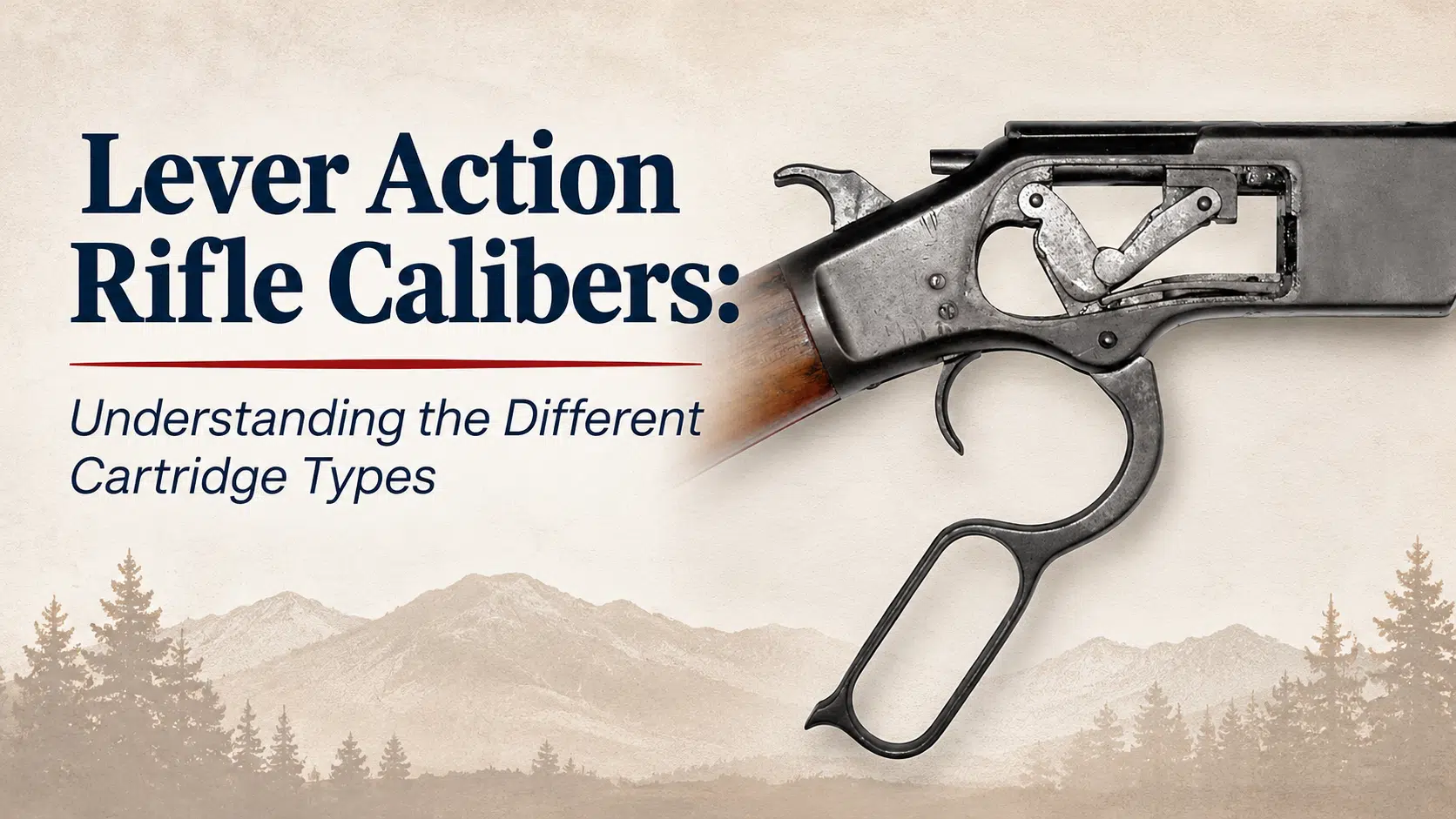
Few firearms are as closely connected to American history as the lever action rifle. From frontier-era repeaters to modern sporting rifles, the lever-action design has remained recognizable for more than 160 years. Yet today’s rifles are available in a surprisingly diverse range of cartridges, from the familiar .22 Long Rifle to full-power centerfire rifle rounds.
Understanding lever action rifle calibers means looking beyond bullet diameter. Cartridge dimensions, rimfire versus centerfire ignition, magazine design, and the strength of a particular firearm action all help explain why certain cartridges became associated with rifles.
This guide explores traditional and modern lever-action chamberings, including .22 LR, .357 Magnum, 9mm Luger, .30-30 Winchester, .308 Winchester, and .45-70 Government. It also examines how manufacturers such as Winchester, Henry, and Marlin shaped the evolution of this distinctly American firearm.
What Is a Lever Action Rifle?
A lever action rifle is a repeating firearm that uses a manually operated lever, typically positioned beneath the receiver, to cycle its action. The design became widely recognized in the 19th century and remains a familiar feature of sporting and historical firearms.
Unlike a bolt-action rifle, which uses a manually manipulated bolt handle, a traditional lever-action rifle uses a lever linked to its internal operating mechanism.
Although lever-action firearms are often associated with Western movies and cowboy rifles, they represent several different mechanical designs. Some have tubular magazines beneath the barrel, while others use internal box magazines or detachable magazines.
That distinction matters because not every lever-action rifle is chambered for the same types of ammunition.
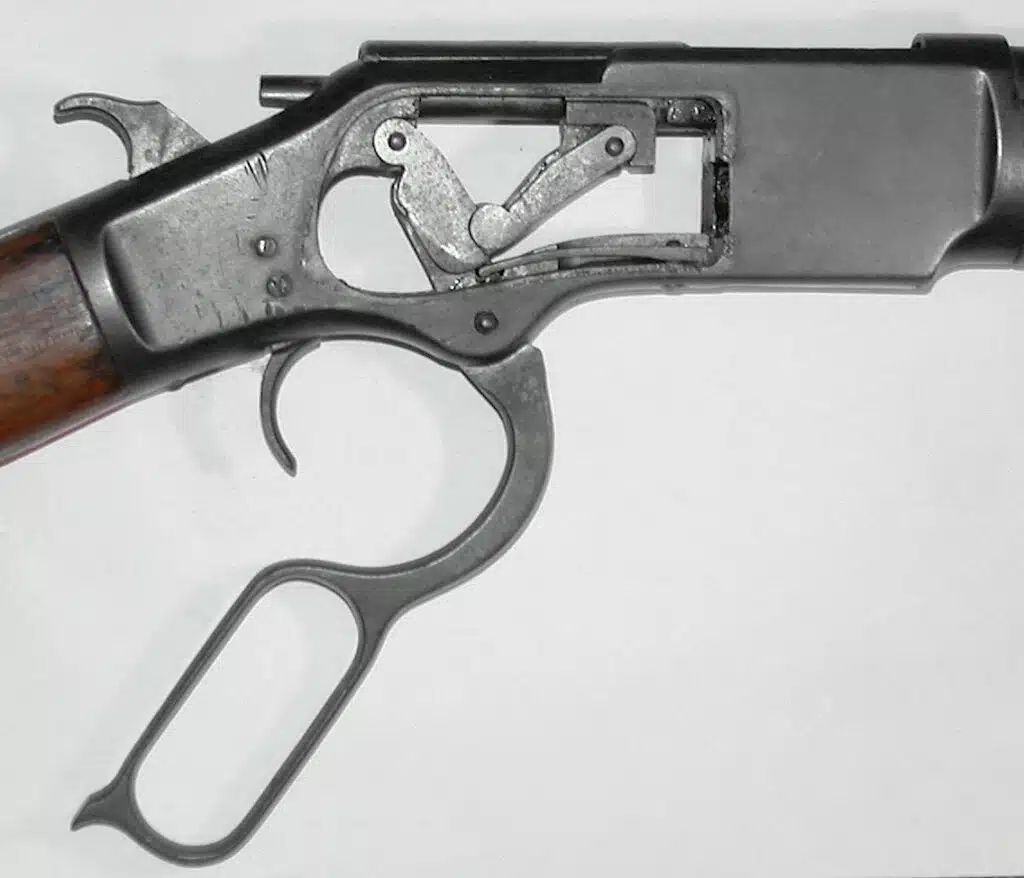
The toggle-link action used in the iconic Winchester Model 1873 rifle, one of the most famous lever-action firearms
Source-Wikipedia
Popular Lever Action Rifle Calibers briefly
The term caliber is commonly used to describe a firearm’s chambering, although caliber and cartridge are not technically identical. Two cartridges can have similar bullet diameters while differing substantially in case dimensions, pressure specifications, and firearm compatibility.
| Cartridge | Ignition type | Traditional or modern examples |
| .22 Long Rifle | Rimfire | Henry Classic Lever Action, Marlin Model 39A |
| .357 Magnum | Centerfire | Marlin 1894, Winchester 1892 variants |
| 44 Magnum | Centerfire | Marlin 1894, Henry Big Boy variants |
| 45 Colt | Centerfire | Winchester 1873 variants |
| 30-30 Winchester | Centerfire | Winchester Model 1894, Marlin 336 |
| 45-70 Government | Centerfire | Marlin 1895, Winchester 1886 |
| 308 Winchester | Centerfire | Browning BLR, Henry Long Ranger |
| 9mm Luger | Centerfire | POF-USA Tombstone |
These examples illustrate documented chamberings, not universal compatibility across every model or production year.
.22 Lever Action Rifle: A Classic Rimfire Chambering
The 22 lever action rifle, commonly chambered in .22 Long Rifle (.22 LR), represents an important part of lever-action history.
Unlike centerfire cartridges, .22 LR ammunition uses a priming compound distributed within the cartridge rim. Its small cartridge dimensions distinguish it from the larger centerfire cartridges associated with many classic Western rifles.
Examples of lever-action .22 rifles include the Henry Classic Lever Action and the historic Marlin Model 39A.
The .22 LR chambering also demonstrates how the lever-action concept evolved beyond the large centerfire cartridges that often dominate discussions of Western firearms.
A lever action 22 rifle is therefore not simply a smaller version of every centerfire lever-action mechanism. Rimfire models may have distinct internal designs and ammunition specifications.
.357 Lever Action Rifle: The Revolver-Cartridge Connection
The 357 lever action rifle reflects the historical connection between lever-action rifles and revolver cartridges.
Introduced in 1935, the .357 Magnum cartridge became associated primarily with revolvers before also becoming established in lever-action carbines.
Modern examples include certain Marlin 1894 and Winchester 1892-pattern rifles.
One particularly interesting aspect of this chambering is its relationship to the earlier .38 Special cartridge. Although the cartridges share a closely related bullet diameter, they have different case lengths and pressure specifications.
Some .357 Magnum firearms are designed to accommodate .38 Special ammunition, but compatibility must always be established from the firearm manufacturer’s documentation. Chamber markings alone should not be treated as a substitute for model-specific guidance.
The .357 Magnum’s place in lever-action history illustrates how handgun cartridges influenced the development of compact sporting rifles.
.30-30 Winchester: A Landmark Lever-Action Cartridge
The .30-30 Winchester is among the cartridges most strongly associated with the American lever-action rifle.
Introduced commercially in 1895, it became closely connected with the Winchester Model 1894 and later the Marlin 336.
The cartridge was significant because it emerged during the transition from black powder to smokeless-powder ammunition. It helped establish the lever-action rifle as a familiar part of 20th-century American sporting culture.
Its rimmed, bottlenecked case also makes it visually distinct from the straight-wall handgun cartridges commonly encountered in other lever-action designs.
At Steinel Ammunition Co., the .30-30 Winchester has been part of the company’s historical ammunition development work. Founder Andy Steinel documented the company’s experimentation with a 140-grain Lehigh projectile in an article examining cartridge consistency and testing results.
Related reading: Steinel’s .30-30 Winchester Load Development
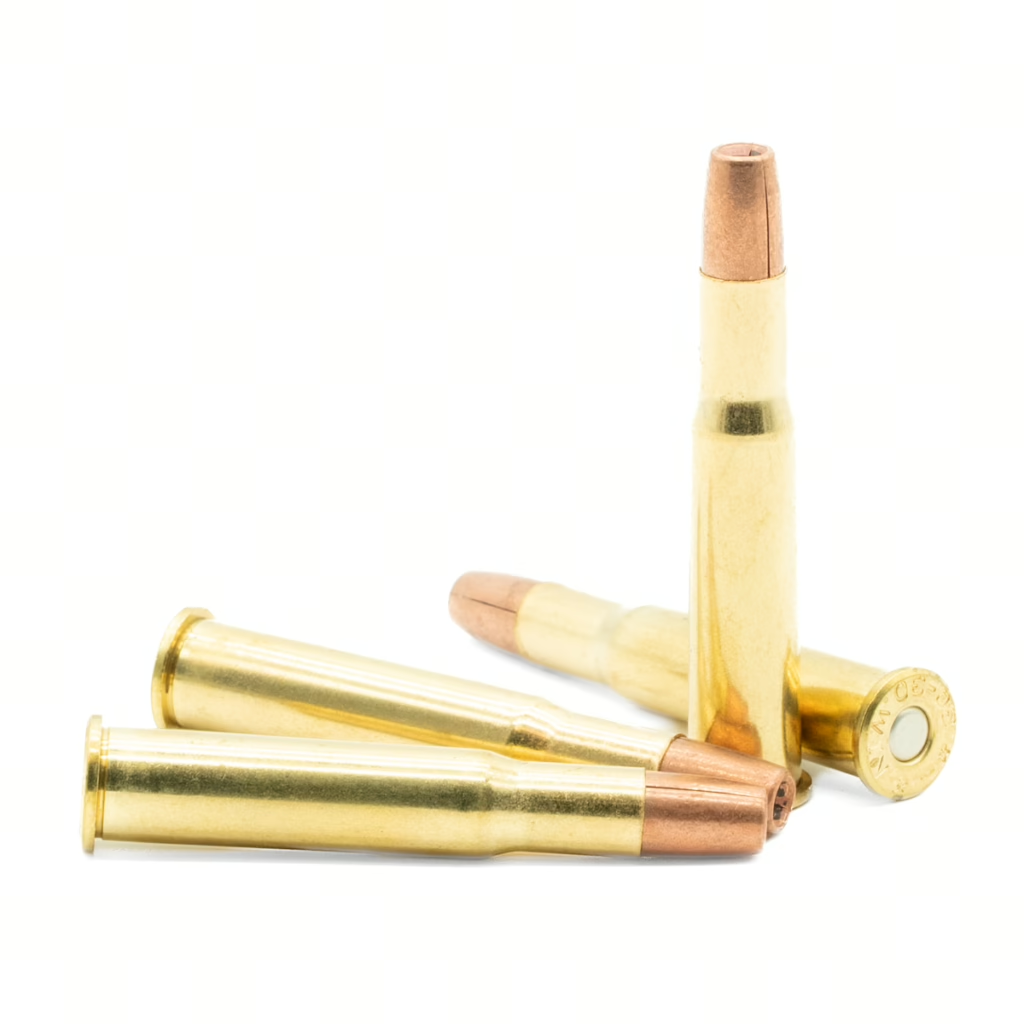
30-30 Winchester 150gr Solid Copper Hollow Point
.44 Magnum and .45 Colt: Traditional Big-Bore Chamberings
The .44 Magnum and .45 Colt are two additional cartridges associated with lever-action rifles.
The .45 Colt dates to 1873 and is closely connected with the history of the American single-action revolver. Its appearance in later lever-action reproductions and modern sporting rifles reflects the continuing popularity of historic Western firearm designs.
The .44 Magnum, introduced in the 1950s, belongs to a considerably later generation of centerfire ammunition. Nevertheless, it became an established chambering in modern lever-action rifles, including variants of the Marlin 1894.
Although both cartridges appear in lever-action firearms, their dimensions and specifications differ. They are not interchangeable.
These cartridges also illustrate why lever-action rifle history cannot be divided neatly between rifle and handgun ammunition.
.45-70 Government: A Cartridge That Outlived Its Original Era
The .45-70 Government cartridge was introduced in 1873 for military single-shot firearms, most notably the Springfield Trapdoor.
It later became associated with large-frame lever-action designs, including the Winchester Model 1886 and Marlin 1895.
The cartridge’s longevity is particularly remarkable. It originated during the black-powder era but remains represented in modern sporting ammunition catalogs.
One important historical distinction is that firearms chambered for .45-70 Government span very different eras and action designs. Ammunition suitability is therefore especially dependent on the individual firearm and its manufacturer’s specifications.
Steinel has previously explored the cartridge’s development and continuing relevance in its educational content.
Related reading: The History of the .45-70 Cartridge & Why It’s Still Relevant After 150 Years, available in the Steinel ammunition blog.

500gr Solid Copper HP 45-70 Government Subsonic Ammo – Advanced Terminal Performance
.308 Lever Action Rifles: Modern Rifle Cartridges in Lever-Action Platforms
Not all lever-action rifles use traditional rimmed cartridges.
308 lever action rifles demonstrate how newer action and magazine designs expanded the range of chamberings available in lever-operated firearms.
The .308 Winchester was introduced in 1952 and became one of the most recognizable modern centerfire rifle cartridges.
Examples of lever-action rifles chambered for .308 Winchester include the Browning BLR and Henry Long Ranger.
These platforms differ significantly from the classic tubular-magazine rifles associated with the American frontier.
The .308 Winchester also provides a useful example of why firearms with similar external operating levers may have fundamentally different internal mechanisms.
For a broader explanation of this cartridge, read Steinel’s 300 Blackout vs. 308 comparisons.
9mm Lever Action Rifle: An Unusual Modern Combination
A 9mm lever action rifle might sound unusual to readers familiar with traditional Winchester and Marlin designs.
The 9mm Luger cartridge was introduced in 1902 and is most associated with semiautomatic handguns and pistol-caliber carbines rather than classic lever-action rifles.
However, modern manufacturers have incorporated the cartridge into lever-operated platforms.
One notable example is the POF-USA Tombstone, introduced in 2023. Unlike most traditional lever-action rifles, the Tombstone uses a detachable box magazine.
Its existence illustrates how contemporary firearm manufacturers continue to reinterpret historical operating systems.
The 9mm lever-action category remains a specialized part of the wider lever-action market rather than a traditional chambering associated with the 19th-century rifle designs.
Marlin Lever Action Rifles: How One Manufacturer Shaped the Category
Any discussion of lever-action history would be incomplete without Marlin lever action rifles.
Marlin developed several influential rifle families during the late 19th and 20th centuries, contributing to the widespread adoption of lever-action firearms for sporting purposes.
Three particularly recognizable examples are:
- Marlin Model 39A: A historic rimfire lever-action rifle associated with .22-caliber ammunition.
- Marlin Model 336: A centerfire lever-action family historically associated with cartridges including .30-30 Winchester.
- Marlin Model 1894: A compact centerfire lever-action family associated with revolver cartridges such as .357 Magnum and .44 Magnum.
The Marlin Model 1895 is another significant design, particularly because of its association with .45-70 Government.
These rifles demonstrate that the Marlin name covers multiple action sizes, cartridge families, and generations of firearm design rather than one universal lever-action platform.
What Is a Tactical Lever Action Rifle?
The expression tactical lever action rifle generally describes a modernized lever-operated firearm incorporating contemporary styling or features.
The term is largely descriptive rather than a standardized mechanical classification.
Modern examples may feature synthetic furniture, accessory mounting interfaces, or other design elements that visually distinguish them from traditional wood-stocked rifles.
Importantly, a tactical-style lever-action rifle is not necessarily chambered for a different cartridge from its more traditional counterpart.
Some modernized rifles retain established chamberings such as .357 Magnum, .44 Magnum, .30-30 Winchester, or .45-70 Government. Others represent less conventional combinations, including 9mm Luger.
For this reason, the word tactical describes the firearm’s configuration more than its cartridge family.
Steinel has also covered this subject separately in its article Best Ammo for Tactical Lever Action Rifles. Readers interested in that specific topic can explore the existing article in the company’s blog library.
The First Lever Action Rifle: Where Did the Design Begin?
The story of the first lever action rifle is more complicated than the popular image of a Winchester cowboy rifle.
Early lever-operated repeating firearms existed before the famous Henry and Winchester designs.
Colt produced ring-lever repeating rifles during the 1830s, representing an early application of lever-operated mechanisms.
Walter Hunt’s experimental Volition repeater and the subsequent Jennings designs helped establish ideas that influenced later lever-action firearms.
During the 1850s, the Volcanic repeating firearms introduced additional concepts that would eventually contribute to the development of the Henry rifle.
In 1860, Benjamin Tyler Henry patented his improved repeating rifle, which used a self-contained .44-caliber rimfire cartridge.
The Henry became an important predecessor to the Winchester Model 1866 and Model 1873.
By the late 19th century, manufacturers such as Winchester and Marlin had introduced lever-action rifles chambered for numerous rimfire and centerfire cartridges.
The historical significance of these developments extends beyond the rifles themselves. Improvements in metallic cartridge design were essential to the evolution of practical repeating firearms.
How Cartridge Design Influenced Lever-Action Rifle Development
One of the most interesting aspects of lever-action history is the relationship between ammunition design and firearm mechanisms.
Early repeating rifles faced limitations involving the ammunition available at the time. The emergence of reliable self-contained metallic cartridges made repeating designs more practical.
As cartridge technology evolved, rifle manufacturers introduced different operating mechanisms and magazine configurations.
Rimfire vs. Centerfire Cartridges
Rimfire cartridges, such as .22 LR, contain their priming compound within the cartridge rim.
Centerfire cartridges, including .357 Magnum, .30-30 Winchester, and .308 Winchester, use a separate primer positioned in the center of the case head.
The distinction represents two fundamentally different ammunition ignition systems.
Straight-Wall vs. Bottleneck Cartridges
Cartridge case shape is another important distinction.
The .357 Magnum, .44 Magnum, and .45-70 Government are examples of cartridges with substantially straight case walls.
The .30-30 Winchester and .308 Winchester use bottlenecked cases, in which the case body narrows toward the neck.
Neither case shape is exclusive to lever-action rifles, but both appear throughout their history.
Why Magazine Design Matters
Traditional lever-action firearms frequently use tubular magazines, while some modern or specialized models use box magazines.
This difference influenced which cartridge designs were incorporated into particular firearms.
For example, the Browning BLR and Henry Long Ranger illustrate the use of box-magazine configurations in lever-action rifles chambered for modern centerfire cartridges.
The relationship between ammunition design and magazine construction helps explain why the lever-action category contains more mechanical variety than its familiar appearance might suggest.
Understanding Ammunition Compatibility in Lever-Action Rifles
Cartridge identification is especially important when discussing rifles with long production histories.
Two firearms sharing the same model name may have different chamberings depending on their production year or exact variant.
Likewise, cartridges that appear similar are not necessarily interchangeable.
The correct ammunition designation must match the firearm manufacturer’s specifications. This is particularly important for older collectible firearms, firearms with unclear markings, and designs produced across multiple generations.
At Steinel Ammunition Co., historical cartridge knowledge and modern ammunition manufacturing intersect. The company’s work with vintage and specialty ammunition reflects the continuing importance of preserving accurate cartridge specifications.
Frequently Asked Questions About Lever Action Rifle Calibers
Q1. When was the lever action rifle invented?
A. The lever-action rifle originated in the 1830s, with Samuel Colt’s ring-lever revolving rifle entering production in 1837. Benjamin Tyler Henry later introduced his influential lever-action repeating rifle in 1860, helping popularize the design in America.
Q2. Are lever action rifles legal in California?
A. Yes, most traditional manually operated lever-action rifles are legal in California. However, specific firearm configurations, magazine restrictions, and other state regulations may apply. Buyers should verify current requirements with the California Department of Justice
Q3. Who makes the best lever action rifles?
A. Henry, Marlin, Winchester, and Browning are among the most recognized lever-action rifle manufacturers. Each offers different designs, calibers, and features. The best manufacturer depends on individual preferences, intended use, and firearm specifications.
Q4. Are lever action rifles reliable?
A. Yes, well-manufactured and properly maintained lever-action rifles are generally reliable. Their manually operated mechanisms have demonstrated dependable performance for generations. Reliability varies by firearm model, condition, maintenance, and ammunition compatibility.
Final Thoughts
Lever-action rifles have survived successive generations of firearm innovation because the design has proven remarkably adaptable.
From early .44 rimfire repeaters and classic .30-30 sporting rifles to modern .308 and 9mm platforms, their history reflects changes in ammunition technology, manufacturing, and firearm engineering.
Understanding lever action rifle calibers is ultimately about recognizing that no single cartridge or operating mechanism defines the entire category.
For enthusiasts interested in the ammunition history behind these rifles, Steinel Ammunition Co. continues to document classic and specialty cartridges through its educational articles and technical research.
The lever-action rifle remains an enduring example of American firearms history, connecting the earliest repeating mechanisms with contemporary cartridge designs